issues with translation
PHIL 220. Introduction to Logic
issues with translation
Special quantifier phrases and structural ambiguity.
overview
Some quantifier phrases call for different quantifiers in different contexts: ‘a \(P\)’, ‘only \(P\)’, ‘no \(P\)’, ‘any \(P\)’.
Sentences with multiple quantifiers often give rise to structural ambiguity.
special quantifier phrases
‘a \(P\)’, ‘only \(P\)’, ‘no \(P\)’, and ‘any \(P\)’.
a \(P\)
The indefinite article ‘a’ often gives rise to ambiguity. Context often makes one interpretation more salient than the other:
A whale lives underwater.
A whale came close to shore.
Every whale lives underwater. Some whale lives underwater.
Some whale came close to shore. Every whale came close to shore.
a whale lives underwater
translation key
Domain: Animals
\(Px\): \(x\) is a whale
\(Qx\): \(x\) lives underwater
\(Rx\): \(x\) came close to shore
For every thing, if it is a whale, then it lives underwater.
For every \(x\), (\(x\) is a whale \(\to\) \(x\) lives underwater).
\[ \forall x \ (Px \to Qx) \]
a whale came close to shore
translation key
Domain: Animals
\(Px\): \(x\) is a whale
\(Qx\): \(x\) lives underwater
\(Rx\): \(x\) came close to shore
For some thing, it is a whale and it came close to shore.
For some \(x\), (\(x\) is a whale \(\wedge\) \(x\) came close to shore).
\[ \exists x \ (Px \wedge Rx) \]
the unheard interpretations
A whale lives underwater.
The syntax is consistent with
\[ \exists x \ (Px \wedge Qx) \]
but that interpretation is difficult to hear in common contexts.
A whale came close to shore.
The syntax is consistent with
\[ \forall x \ (Px \to Rx) \]
but that interpretation is difficult to hear in common contexts.
The context, not the grammar, selects the quantifier.
only mammals are whales
translation key
Domain: Animals
\(Px\): \(x\) is a mammal
\(Qx\): \(x\) is a whale
Only mammals are whales.
Every whale is a mammal.
For every \(x\), \(x\) is a whale only if \(x\) is a mammal.
For every \(x\), (if \(x\) is a whale, then \(x\) is a mammal).
\[ \forall x \ (Qx \to Px) \]
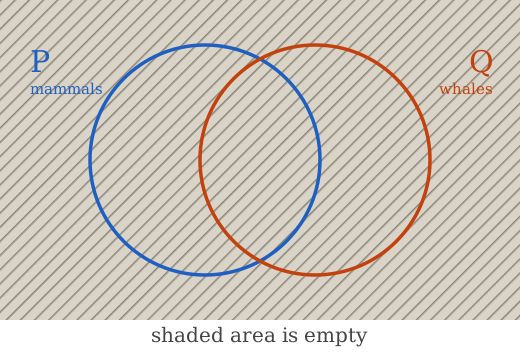
The area of \(Q\) outside \(P\) is empty.
a common mistake
Only mammals are whales.
\[ \forall x \ (Qx \to Px) \]
Every whale is a mammal. True.
Only mammals are whales.
\(\forall x \ (Px \to Qx)\)
Every mammal is a whale. False. Elephants are mammals.
The mistaken translation turns a true sentence into a false one. In general:
‘Only \(P\) are \(Q\)’ reverses the conditional: ‘all \(Q\) are \(P\)’.
only, inside a quantifier
translation key
Domain: Animals
\(Qx\): \(x\) is a whale
\(Rx\): \(x\) is krill
\(Sxy\): \(x\) eats \(y\)
Some whales eat only krill.
For some \(x\), \(x\) is a whale and \(x\) eats only krill.
For some \(x\), (\(x\) is a whale \(\wedge\) \(x\) eats only krill\()\)
\(x\) eats only krill \(\;\leadsto\;\) for every \(y\), (\(x\) eats \(y\) \(\to\) \(y\) is krill)
For some \(x\), (\(x\) is a whale \(\wedge\) for every \(y\), (\(x\) eats \(y\) \(\to\) \(y\) is krill)).
\[ \exists x \ (Qx \wedge \forall y \ (Sxy \to Ry)) \]
no \(P\)
translation key
Domain: Animals
\(Px\): \(x\) is a whale
\(Qx\): \(x\) is a fish
No whale is a fish.
All whales are not fish.
For every \(x\), (\(x\) is a whale \(\to\) \(\neg\) \(x\) is a fish).
\[ \forall x \ (Px \to \neg Qx) \]
It’s not the case that some whales are fish.
\(\neg\) for some \(x\), (\(x\) is a whale \(\wedge\) \(x\) is a fish).
\[ \neg \exists x \ (Px \wedge Qx) \]
Both translations are acceptable: they are equivalent.
any
One difficulty with ‘any’ is that it calls for different quantifiers in different contexts.
translation key
Domain: Animals
\(Px\): \(x\) is a whale
\(Qx\): \(x\) breathes air
Any whale breathes air.
All whales breathe air.
For every \(x\), (\(x\) is a whale \(\to\) \(x\) breathes air).
\[ \forall x \ (Px \to Qx) \]
‘any’ in an antecedent
translation key
Domain: Animals
\(Px\): \(x\) is a whale
\(Qx\): \(x\) breathes air
If any whale breathes air, then they all do.
If some whale breathes air, then all whales breathe air.
If (for some \(x\), (\(x\) is a whale \(\wedge\) \(x\) breathes air) \(\to\) for every \(x\), (\(x\) is a whale \(\to\) \(x\) breathes air).
\[ \exists x \ (Px \wedge Qx) \to \forall x \ (Px \to Qx) \]
Here ‘any’ becomes \(\exists\), not \(\forall\).
any v every
If any whale breathes air, then they all do.
\[ (\exists x \ (Qx \wedge Rx) \to \forall x \ (Qx \to Rx)) \]
Informative.
If every whale breathes air, then they all do.
\[ \forall x \ (Qx \to Rx) \to \forall x \ (Qx \to Rx) \]
Trivial.
structural ambiguity
Multiple generality and the order of quantifiers.
everything has a cause
translation key
Domain: Events
\(Rxy\): \(x\) causes \(y\)
Everything has a cause.
There are two candidate interpretations:
Everything has some cause or another.
Some one thing is the cause of everything.
everything has some cause or another
translation key
Domain: Events
\(Rxy\): \(x\) causes \(y\)
Everything has some cause or another.
For every \(x\), \(x\) has a cause.
For every \(x\), for some \(y\), \(y\) causes \(x\).
\[ \forall x \ \exists y \ Ryx \]
something is a cause of everything
translation key
Domain: Events
\(Rxy\): \(x\) causes \(y\)
Something is a cause of everything.
For some \(x\), \(x\) causes everything.
For some \(x\), for every \(y\), \(x\) causes \(y\).
\[ \exists x \ \forall y \ Rxy \]
which one is correct?
We rely on contextual cues to identify the intended interpretation.
In case of doubt, provide both translations and explain that the target sentence is ambiguous between them.
every student must register for some logic class
translation key
Domain: Students and courses
\(Px\): \(x\) is a student
\(Qx\): \(x\) is a logic class
\(Rxy\): \(x\) registers for \(y\)
Every student must register for some logic class.
Again a choice between two non-equivalent interpretations:
Each student must register for some logic class or another.
There is one logic class every student must register for.
interpretation 1
translation key
Domain: Students and courses
\(Px\): \(x\) is a student
\(Qx\): \(x\) is a logic class
\(Rxy\): \(x\) registers for \(y\)
Each student must register for some logic class or another.
For every \(x\), (\(x\) is a student \(\to\) \(x\) must register for some logic class\()\)
\(x\) must register for some logic class \(\;\leadsto\;\) for some \(y\), (\(y\) is a logic class \(\wedge\) \(x\) must register for \(y\))
For every \(x\), (\(x\) is a student \(\to\) some \(y\) is such that (\(y\) is a logic class \(\wedge\) \(x\) must register for \(y\))).
\[ \forall x \ (Px \to \exists y \ (Qy \wedge Rxy)) \]
interpretation 2
translation key
Domain: Students and courses
\(Px\): \(x\) is a student
\(Qx\): \(x\) is a logic class
\(Rxy\): \(x\) registers for \(y\)
There is one logic class every student must register for.
For some \(x\), (\(x\) is a logic class \(\wedge\) every student must register for \(x\)\()\).
every student must register for \(x\) \(\;\leadsto\;\) for every \(y\), (\(y\) is a student \(\to\) \(y\) must register for \(x\))
For some \(x\), (\(x\) is a logic class \(\wedge\) for every \(y\), (\(y\) is a student \(\to\) \(y\) must register for \(x\))).
\[ \exists x \ (Qx \wedge \forall y \ (Py \to Ryx)) \]
the two interpretations pictured
Students \(a\), \(b\), \(c\); logic classes \(d\), \(e\). An arrow from \(x\) to \(y\) means \(x\) registers for \(y\).
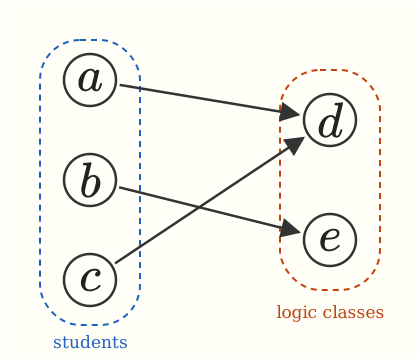
Interpretation 1: true
Interpretation 2: false
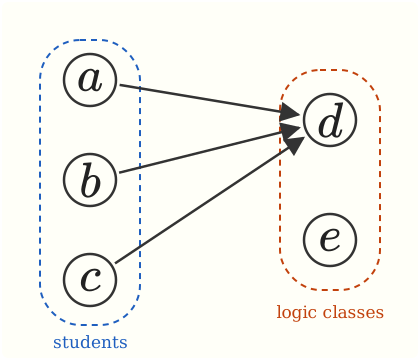
Interpretation 1: true
Interpretation 2: true
Interpretation 2 entails reading 1, but not conversely.
no ambiguity here
translation key
Domain: Students and courses
\(Px\): \(x\) is a student
\(Qx\): \(x\) is a logic course
\(Rxy\): \(x\) registers for \(y\)
Every student must register for every logic course.
For every \(x\), (\(x\) is a student \(\to\) \(x\) must register for every logic course\()\)
\(x\) must register for every logic course \(\;\leadsto\;\) for every \(y\), (\(y\) is a logic class \(\to\) \(x\) must register for \(y\))
For every \(x\), (\(x\) is a student \(\to\) for every \(y\), (\(y\) is a logic course \(\to\) \(x\) must register for \(y\))).
\[ \forall x \ (Px \to \forall y \ (Qy \to Rxy)) \]
check your translation
Every translation should be a closed formula.