translation into quantificational logic

PHIL 220. Introduction to Logic

Gabriel Uzquiano

translation

We build on the strategies we used for propositional logic, but now use the vocabulary of quantificational logic to identify further structure.

the strategy

  1. We first explain how the target sentence is built from simpler sentences with the help of propositional connectives.

  2. We do not let propositional variables to stand for those simpler sentences, but rather use predicates, constants, variables, and quantifiers to display their internal structure.

predication

Designators and predicates.

example

Aristotle followed Plato, but Plato followed Socrates. Aristotle and Plato followed each other. Therefore, Aristotle followed Socrates only if Plato did.

  1. Aristotle followed Plato, but Plato followed Socrates.
  2. Aristotle and Plato followed each other.
  3. Aristotle followed Socrates only if Plato did.

premise

translation key

Domain: People

\(Rxy\): \(x\) followed \(y\)

\(a\): Aristotle

\(b\): Plato

\(c\): Socrates

Aristotle followed Plato, but Plato followed Socrates.

(Aristotle followed Plato \(\wedge\) Plato followed Socrates)

\[ (Rab \wedge Rbc) \]

premise

translation key

Domain: People

\(Rxy\): \(x\) followed \(y\)

\(a\): Aristotle

\(b\): Plato

\(c\): Socrates

Aristotle and Plato followed each other.

(Aristotle followed Plato \(\wedge\) Plato followed Aristotle)

\[ (Rab \wedge Rba) \]

conclusion

translation key

Domain: People

\(Rxy\): \(x\) followed \(y\)

\(a\): Aristotle

\(b\): Plato

\(c\): Socrates

Aristotle followed Socrates only if Plato did.

(Aristotle followed Socrates \(\to\) Plato followed Socrates)

\[ (Rac \to Rbc) \]

quantification

Quantifier phrases require more care. We begin with the simplest cases.

something

Something is heavy.

translation key

Domain: Objects

\(Px\): \(x\) is heavy

Some thing is such that it is heavy.

Some \(x\) is such that \(x\) is heavy.

\[ \exists x \ Px \]

Everything is made of matter.

translation key

Domain: Objects

\(Qx\): \(x\) is made of matter

Every thing is such that it is made of matter.

Every \(x\) is such that \(x\) is made of matter.

\[ \forall x \ Qx \]

nothing

Nothing lasts forever.

‘Nothing’ is not a designator.

translation key

Domain: Objects

\(Rx\): \(x\) lasts forever

Not the case that some thing is such that it lasts forever.

\(\neg\) some \(x\) is such that \(x\) lasts forever.

\[ \neg \exists x \ Rx \]

Every thing is such that it does not last forever.

Every \(x\) is such that \(\neg\) \(x\) lasts forever.

\[ \forall x \ \neg Rx \]

some apples are delicious

Some apples are delicious.

translation key

Domain: Objects

\(Px\): \(x\) is an apple

\(Qx\): \(x\) is delicious

Some thing is such that it is an apple and it is delicious.

Some \(x\) is such that (\(x\) is an apple \(\wedge\) \(x\) is delicious).

\[ \exists x \ (Px \wedge Qx) \]
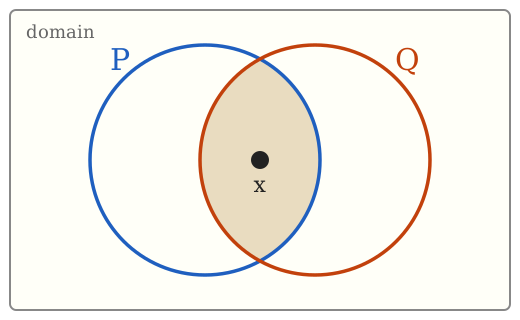
The overlap between \(P\) and \(Q\) is not empty.

Every computer is expensive

Every computer is expensive.

translation key

Domain: Objects

\(Px\): \(x\) is a computer

\(Qx\): \(x\) is expensive

Every thing is such that it is expensive if it is a computer.

Every thing is such that if it is a computer, then it is expensive.

Every \(x\) is such that (\(x\) is a computer \(\to\) \(x\) is expensive).

\[ \forall x \ (Px \to Qx) \]
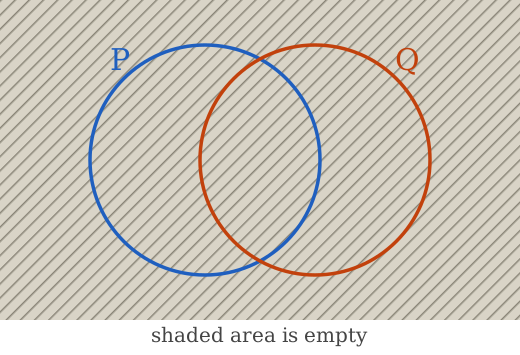
The area of \(P\) outside \(Q\) is empty.

why the difference?

\[ \exists x(Px \wedge Qx) \]

\(\exists\) generally pairs with \(\wedge\)

Some apples are delicious

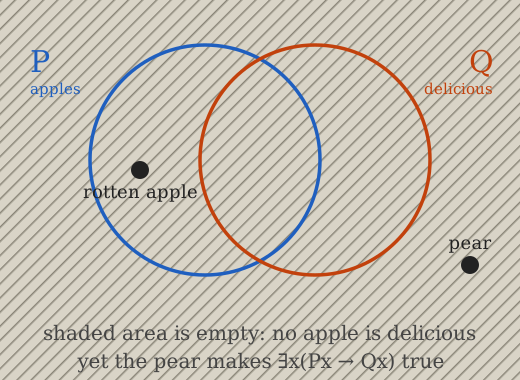
\(\exists x(Px \to Qx)\) ✗

That corresponds to the claim that something is delicious if it is an apple.

A pear makes it true, even if no apples are delicious.
\[ \forall x(Px \to Qx) \]

\(\forall\) generally pairs with \(\to\)

Every computer is expensive

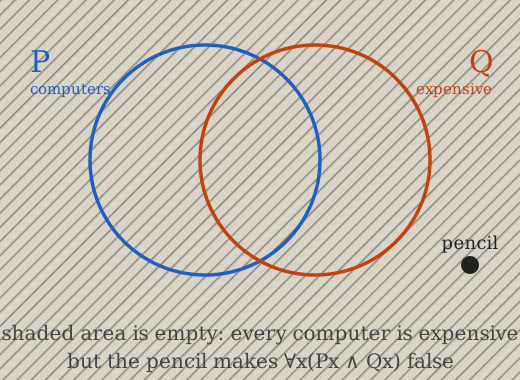
\(\forall x(Px \wedge Qx)\) ✗

That corresponds to everything is both a computer and expensive.

A pencil makes it false even if every computer is expensive.
the network

Some computers are connected to the network.

translation key

Domain: Objects

\(Px\): \(x\) is a computer

\(Rxy\): \(x\) is connected to \(y\)

\(a\): the network

Some thing is such that it is a computer and it is connected to the network.

Some \(x\) is such that (\(x\) is a computer \(\wedge\) \(x\) is connected to \(a\)).

\[ \exists x \ (Px \wedge Rxa) \]

Every computer is connected to the network.

Every thing is such that if it is a computer, then it is connected to the network.

Every \(x\) is such that (\(x\) is a computer \(\to\) \(x\) is connected to \(a\)).

\[ \forall x \ (Px \to Rxa) \]

multiple generality

Multiple generality involves predicates with more than one argument place.

translation key

Domain: people

\(Rxy\): \(x\) follows \(y\)

\(Px\): \(x\) is a philosopher

\(Qx\): \(x\) is a mathematician

\(a\): Aristotle

\(b\): Plato

  • Aristotle followed Plato.

  • \(Rab\)

  • Someone followed Plato.

  • \(\exists x Rxb\)

  • Aristotle followed someone.

  • \(\exists x Rax\)

  • Everyone followed Plato.

  • \(\forall x Rxb\)

  • Aristotle followed everyone.

  • \(\forall x Rax\)

  • Someone followed someone.

  • \(\exists x \exists y Rxy\)

  • Someone followed everyone.

  • \(\exists x \forall y Rxy\)

  • Everyone followed someone.

  • \(\forall x \exists y Rxy\)

  • Everyone followed everyone.

  • \(\forall x \forall y Rxy\)

the order of quantifiers

Consider a domain of three individuals \(a\), \(b\), \(c\). We use an arrow from \(x\) to \(y\) to represent the fact that \(x\) followed \(y\).
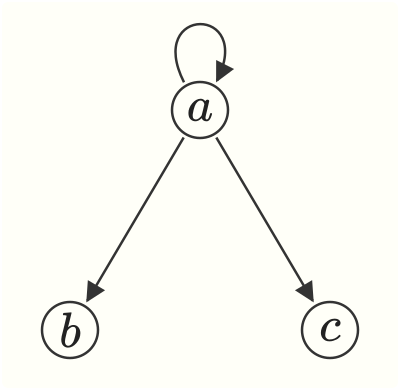
  • \(\exists x \forall y Rxy\)

  • True. \(a\) followed every individual, including \(a\) itself.

  • \(\forall x \exists y Rxy\)

  • False. Neither \(b\) nor \(c\) followed anyone.
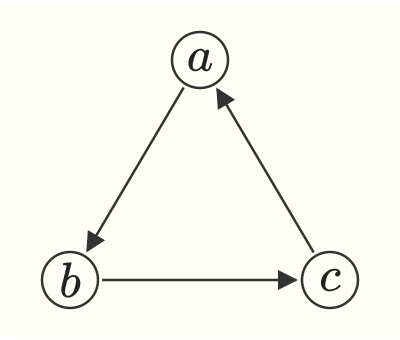
  • \(\exists x \forall y Rxy\)

  • False. No individual followed every individual.

  • \(\forall x \exists y Rxy\)

  • True. Everyone followed someone.

multiple generality

Multiple generality involves predicates with more than one argument place.

translation key

Domain: people

\(Rxy\): \(x\) follows \(y\)

\(Px\): \(x\) is a philosopher

\(Qx\): \(x\) is a mathematician

\(a\): Aristotle

\(b\): Plato

  • Some philosopher followed Plato.

  • \(\exists x (Px \wedge Rxb)\)

  • Plato followed some philosophers.

  • \(\exists x (Px \wedge Rbx)\)

  • Every philosopher followed Plato

  • \(\forall x (Px \to Rxb)\)

  • Plato followed every philosopher

  • \(\forall x (Px \to Rbx)\)

  • No philosopher followed Plato

  • \(\neg \exists x (Px \wedge Rxb)\)

  • \(\forall x (Px \to \neg Rxb)\)

outside in

Every philosopher followed some mathematicians.

We proceed in three steps:

  • We translate the outer phrase first:

    \(\forall x(Px \to\) \(x\) followed some mathematician\()\)

  • Translate the box on its own:

    \(x\) followed some mathematician \(\;\leadsto\;\) \(\exists y(Qy \wedge R\)\(x\)\(y\)\()\)

  • Plug the partial translation back in:

    \(\forall x(Px \to \exists y(Qy \wedge Rxy))\)

some philosophers, every mathematician

Some philosophers followed every mathematician.

  • We translate the outer phrase first:

    \(\exists x(Px \ \wedge\) \(x\) followed every mathematician\()\)

  • Translate the box on its own:

    \(x\) followed every mathematician \(\;\leadsto\;\) \(\forall y(Qy \to R\)\(x\)\(y\)\()\)

  • Plug the partial translation back in:

    \(\exists x(Px \wedge \forall y(Qy \to Rxy))\)

every philosopher, every mathematician

Every philosopher followed every mathematician.

  • We translate the outer phrase first:

    \(\forall x(Px \ \to\) \(x\) followed every mathematician\()\)

  • Translate the box on its own:

    \(x\) followed every mathematician \(\;\leadsto\;\) \(\forall y(Qy \to R\)\(x\)\(y\)\()\)

  • Plug the partial translation back in:

    \(\forall x(Px \to \forall y(Qy \to Rxy))\)

how to translate back to English

What claims do these make?

translation key

Domain: people

\(Rxy\): \(x\) follows \(y\)

\(Px\): \(x\) is a philosopher

\(\exists x \forall y Ryx\) Someone is followed by everyone.
\(\forall y \exists x Rxy\) Everyone is followed by someone.
\(\neg \exists x(Px \wedge Rxx)\) No philosophers followed themselves.
\(\forall x(Px \to \exists y(Py \wedge Ryx))\) Every philosopher is followed by some philosopher.