basic language
PHIL 452 · Modal Logic
modal propositional logic
basic language
Choose a stock of propositional variables or atoms:
\[ AT := p, q, r, \cdots \]
We define the formulas of a propositional language \(\mathcal{L}\) recursively:
\[ \varphi ::= AT \ | \ \neg \varphi \ | \ (\varphi \to \psi) \ | \Box \varphi \]
All atoms are formulas.
If \(\varphi\) is a formula, then \(\neg \varphi\) is a formula.
If \(\varphi\) and \(\psi\) are formulas, then \((\varphi \to \psi)\) is a formula.
If \(\varphi\) is a formula, then \(\Box \varphi\) is a formula.
Nothing else is a formula.
some definitions
\[ \begin{array}{lll} \top & := & (p \to p)\\ \bot & := & \neg \top \\ (\varphi \vee \psi) & := & (\neg \varphi \to \psi)\\ (\varphi \wedge \psi) & := & \neg (\varphi \to \neg \psi)\\ (\varphi \leftrightarrow \psi) & := & (\varphi \to \psi) \wedge (\psi \to \varphi)\\ \Diamond \varphi & := & \neg \Box \neg \varphi\\ \end{array} \]
induction on the complexity of formulas
Given a condition on formulas of \(\mathcal{L}^\Box\), if
all atoms meet the condition,
a formula \(\varphi\) meets the condition only if \(\neg \varphi\) does,
two formulas \(\varphi\) and \(\psi\) meet the condition only if \((\varphi \to \psi)\) does, and
a formula \(\varphi\) meets the condition only if \(\Box \varphi\) does,
then all formulas of \(\mathcal{L}\) meet the condition.
uniform substitution
Given a formula \(\varphi\) with propositional variables \(p_1, \dots, p_n\) and formulas \(\psi_1, \dots, \psi_n\), we define
\[ \varphi[\psi_1/p_1, \dots, \psi_n/p_n] \]
by the recursion:
\[ \begin{array}{lll} p_i[\psi_1/p_1, \dots, \psi_n/p_n] & := & \psi_i \\ (\neg \chi) [\psi_1/p_1, \dots, \psi_n/p_n] & := & \neg \chi[\psi_1/p_1, \dots, \psi_n/p_n] \\ (\chi \to \rho)[\psi_1/p_1, \dots, \psi_n/p_n] & := & (\chi[\psi_1/p_1, \dots, \psi_n/p_n] \to \rho[\psi_1/p_1, \dots, \psi_n/p_n])\\ (\Box \chi) [\psi_1/p_1, \dots, \psi_n/p_n] & := & \Box \chi[\psi_1/p_1, \dots, \psi_n/p_n] \\ \end{array} \]
. . .
possible worlds semantics
We develop a possible worlds semantics for \(\mathcal{L}^\Box\).
possible worlds models
A possible worlds model \(M\) for \(\mathcal{L}^\Box\) is a structure \((W, R, V)\) where:
\(W\) is a non-empty set of worlds
\(R\) is a binary accessibility relation on \(W\)
\(V\) maps each propositional variable \(p\) to a set of worlds \(V(p) \subseteq W\).
\(Ruv\) is sometimes written \(uRv\) and read: “\(v\) is accessible from \(u\).”
To be accessible from \(u\) is to be possible relative to \(u\).
\(w \in V(p)\) is sometimes read: “\(p\) is true at \(w\).”
\(V(p)\) is the set of worlds at which \(p\) is true.
graphs for possible worlds models
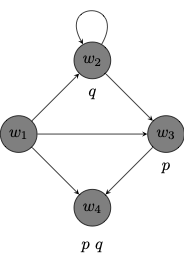
We will use the directed graph to depict a possible worlds model \((W, R, V)\) where:
\(W = \{w_1, w_2, w_3, w_4\}\)
\(R = \{(w_1, w_2), (w_2, w_3), (w_3, w_4), (w_1, w_4), (w_1, w_3), (w_2, w_2)\}\)
\(V\) is a valuation on which:
- \(V(p) = \{w_3, w_4\}\);
- \(V(q) = \{w_2, w_4\}\)
truth at a world
\(\varphi\) is true at a world \(w\) in a possible worlds model \(M\), written \(M, w \Vdash \varphi\):
\[ \begin{array}{lll} M, w \Vdash p & \text{iff} & w \in V(p)\\ M, w \Vdash \neg \varphi & \text{iff} & M, w \nVdash \varphi\\ M, w \Vdash (\varphi \to \psi) & \text{iff} & M, w \nVdash \varphi \ \text{or} \ M, w \Vdash \psi\\ M, w \Vdash \Box \varphi & \text{iff} & \text{for every} \ u \in W \ \text{such that} \ Rwu, \ M, u \Vdash \varphi \end{array} \] Note that \(\Box \varphi\) is true at \(w\) iff \(\varphi\) is true at every accessible world from \(u\).
Given the defintion of \(\Diamond\) in terms of \(\Box\), we find that \[ \begin{array}{lll} M, w \Vdash \Diamond \varphi & \text{iff} & \text{for some} \ u \in W \ \text{such that} \ Rwu, \ M, u \Vdash \varphi\\ \end{array} \]
Note that \(\Diamond \varphi\) is true at \(w\) iff \(\varphi\) is true at some accessible world from \(u\).
example
Evaluate each formula at each possible world in the model:
\(p \to (p \to q)\)
True at \(w_1\), \(w_2\) and \(w_3\). Why?
\(\Box p\)
True at \(w_3\) and \(w_4\). Why?
\(\Diamond \Box p\)
True at \(w_1\), \(w_2\) and \(w_3\). Why?
truth in a model
A formula \(\varphi\) to be true in a possible worlds model \(M\), which we write \(M \Vdash \varphi\) if, and only if, for all \(w\in W\), \(M, w \Vdash \varphi\)
example
Evaluate each formula in the model:
\(\neg p \to \Diamond q\)
True in the model. Why?
\(p \to \Box p\)
True in the model. Why?
\(\Box \Diamond p\)
Not true in the model. Why?
frames
A frame \(F\) for \(\mathcal{L}^\Box\) is an ordered pair \((W, R)\) where:
\(W\) is a non-empty set of worlds, and
\(R\) is a binary accessibility relation on \(W\)
A model \(M\) is based on a frame \(F = (W, R)\) if, and only if, there is an assignment \(V\) such that \(M = (F, V)\). That is, \(M = (W, R, V)\).
validity
A formula \(\varphi\) is valid in a frame \((W, R)\), written \((W, R) \models \varphi\), if, and only if, \(\varphi\) is true in every model \((W, R, V)\) based on the frame \((W, R)\).
That is, the formula remains true across models based on that frame: it is true no matter what sets of worlds we assign to the propositional variables.
A formula \(\varphi\) is valid, written \(\models \varphi\), if, and only if, \(\varphi\) is valid in every frame \((W, R)\).
example
Two valid formulas:
\(\Diamond (p \vee q) \leftrightarrow (\Diamond p \vee \Diamond q)\)
\(p\) or \(q\) can be the case iff \(p\) can be the case or \(q\) can be the case.
\(\Box (p \wedge q) \leftrightarrow (\Box p \wedge \Box q)\)
\(p\) and \(q\) must be the case iff \(p\) must be the case or \(q\) must be the case.
Two invalid formulas:
\(\Diamond (p \wedge q) \leftrightarrow (\Diamond p \wedge \Diamond q)\)
For some \(p\) and \(q\), \(p\) and \(q\) can each be the case even if \(p\) and \(q\) cannot jointly be the case.
\(\Box (p \vee q) \leftrightarrow (\Box p \vee \Box q)\)
For some \(p\) and \(q\), \(p\) or \(q\) must be the case even if none of them must be the case.
validity in a class of frames
A formula \(\varphi\) is valid in a class of frames \(\mathcal{C}\), written \(\models_{\mathcal{C}} \varphi\) if, and only if, \(\varphi\) is valid in every frame \((W, R)\) in the class \(\mathcal{C}\).
For example:
\(\Box p \to p\) is valid in the class of reflexive frames.
\(p \to \Box \Diamond p\) is valid in the class of symmetric frames.
\(\Box p \to \Box \Box p\) is valid in the class of transitive frames.
table
| Formula | Condition on \(R\) | |
|---|---|---|
| \(\textsf{T}\) | \(\Box p \to p\) | reflexive on \(W\) |
| \(\textsf{B}\) | \(p \to \Box \Diamond p\) | symmetric on \(W\) |
| \(\textsf{4}\) | \(\Box p \to \Box \Box p\) | transitive on \(W\) |
| \(\textsf{5}\) | \(\Diamond p \to \Box \Diamond p\) | euclidean on \(W\) |