bisimulations
PHIL 452 · Modal Logic
definition
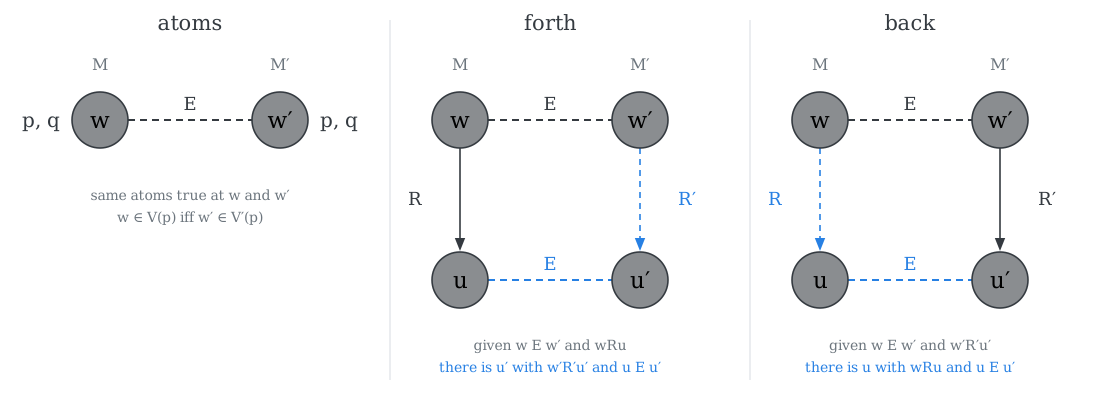
A bisimulation between \((W, R, V)\) and \((W', R', V')\) is a relation \(E \subseteq W \times W'\) where for all \(w \in W\), for all \(w'\in W'\), if \(wEw'\), then:
- \(w \in V(p)\) iff \(w' \in V'(p)\), for all propositional atoms \(p\) (atoms);
- if \(wRu\), then for some \(u' \in W'\), \(w'R'u'\) and \(uEu'\) (forth);
- if \(w'R'u'\), then for some \(u \in W\), \(wRu\) and \(uEu'\) (back).
example: a bisimulation
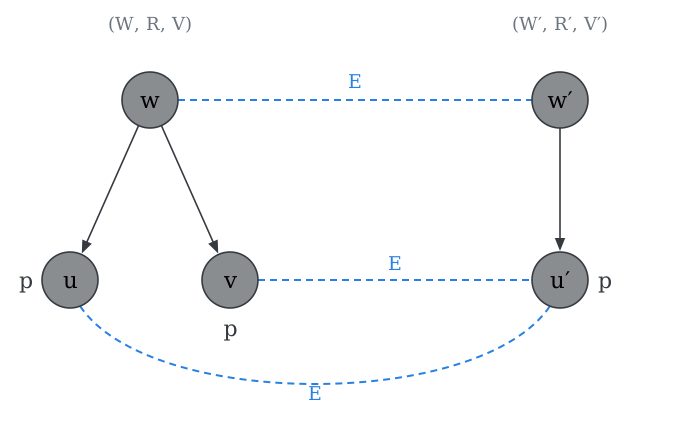
- \(W = \{w, u, v\}\); \(R = \{(w, u), (w, v)\}\); \(V(p) = \{u, v\}\)
- \(W' = \{w', u'\}\); \(R' = \{(w', u')\}\); \(V'(p) = \{u'\}\)
- \(E = \{(w, w'), (u, u'), (v, u')\}\)
\(E\) is a bisimulation between \((W, R, V)\) and \((W', R', V')\):
atoms:
- \(w\) and \(w'\) verify no propositional atoms.
- \(u\), \(v\) and \(u'\) verify just \(p\).
forth:
- since \(wRu\) and \(wRv\), we have \(w'R'u'\) with \(uEu'\) and \(vEu'\).
- \(u\) and \(v\) see nothing.
back:
- since \(w'R'u'\), we have \(wRu\) with \(uEu'\).
- \(u'\) sees nothing.
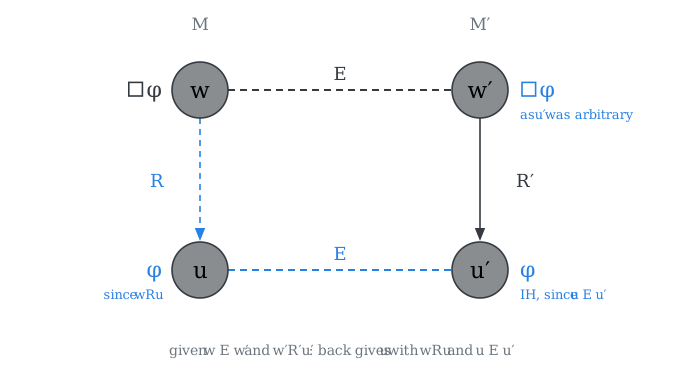
inductive step for \(\Box\): (\(\Rightarrow\))
Assume \(wEw'\) and \(M, w \Vdash \Box\varphi\). Let \(w'R'u'\).
- By \(\textsf{back}\), for some \(u \in W\), \(wRu\) and \(uEu'\).
- Since \(M, w \Vdash \Box\varphi\) and \(wRu\): \(M, u \Vdash \varphi\).
- Since \(uEu'\), by inductive hypothesis: \(M', u' \Vdash \varphi\).
- \(u'\) was arbitrary, so \(M', w' \Vdash \Box\varphi\).
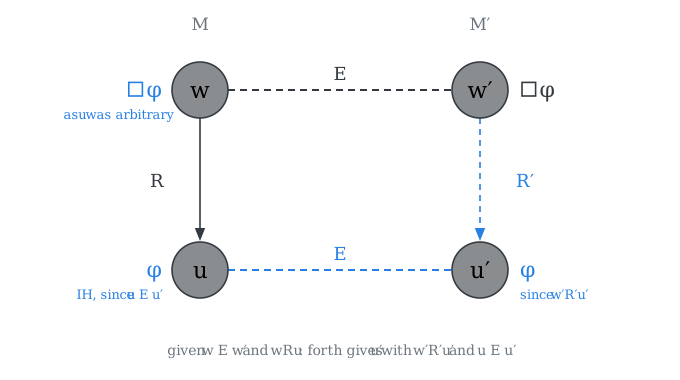
inductive step for \(\Box\): (\(\Leftarrow\))
Suppose \(wEw'\) and \(M', w' \Vdash \Box\varphi\). Let \(wRu\).
- By \(\textsf{forth}\), for some \(u' \in W'\), \(w'R'u'\) and \(uEu'\).
- Since \(M', w' \Vdash \Box\varphi\) and \(w'R'u'\): \(M', u' \Vdash \varphi\).
- Since \(uEu'\), by inductive hypothesis: \(M, u \Vdash \varphi\).
- \(u\) was arbitrary, so \(M, w \Vdash \Box\varphi\).
Every model is bisimilar to some irreflexive model
Given a model \(M = (W, R, V)\), we let \(M' = (W', R', V')\) where
- \(W' = W \times \{0, 1\}\); We write \(w_i\) for \((w, i)\).
- \(w_i R' u_i\) iff \(wRu\) and \(i \neq j\);
- \(w_i \in V'(p)\) iff \(w \in V(p)\).
\(R'\) is irreflexive, since \(i \neq i\) is never the case.
\(E = \{(w, w_i) : w \in W,\ i \in \{0, 1\}\}\) is a bisimulation between the two models:
- atoms:
- trivial by the definition of \(V'\).
- forth:
- if \(wEw_i\) and \(wRu\), then \(w_i R' u_{1-i}\) and \(uEu_{1-i}\).
- back:
- if \(wE w_i\) and \(w_i R' u_j\), then \(wRu\) and \(uE u_j\).
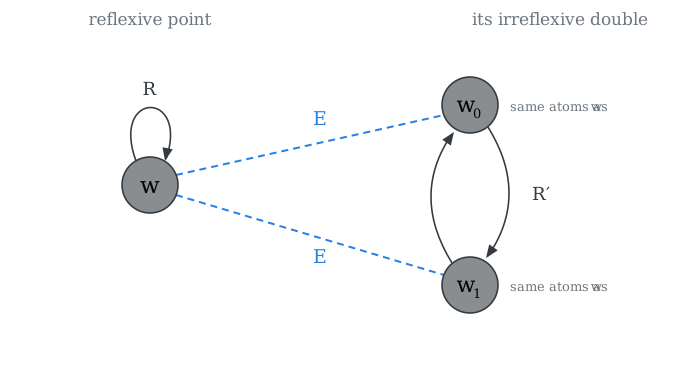
The simplest case: a reflexive point and its double, a two-cycle.
The recipe, and more corollaries
To show that a structural condition \(C\) is not modally definable, find a frame \(G\) in which \(C\) fails such that
- for each model \(M\) based on \(G\) and each world \(w\) in \(M\), there is a model \(N\) based on some frame \(F\) that satisfies \(C\) and a world \(u\) in \(N\), and a bisimulation \(E\) between \(M\) and \(N\) with \(wEv\).
| condition \(C\) | \(G\) lacks \(C\) | \(F\) has \(C\) |
|---|---|---|
| irreflexive | reflexive point | two-cycle |
| asymmetric | reflexive point | \((\mathbb{N}, S)\) |
| intransitive | reflexive point | \((\mathbb{N}, S)\) |
| infinite | reflexive point | \((\mathbb{N}, S)\) |
| antisymmetric | two-cycle | \((\mathbb{N}, S)\) |
In the infinite chain \((\mathbb{N}, S)\):
- \(S = \{(n,m): m = n+1\}\)
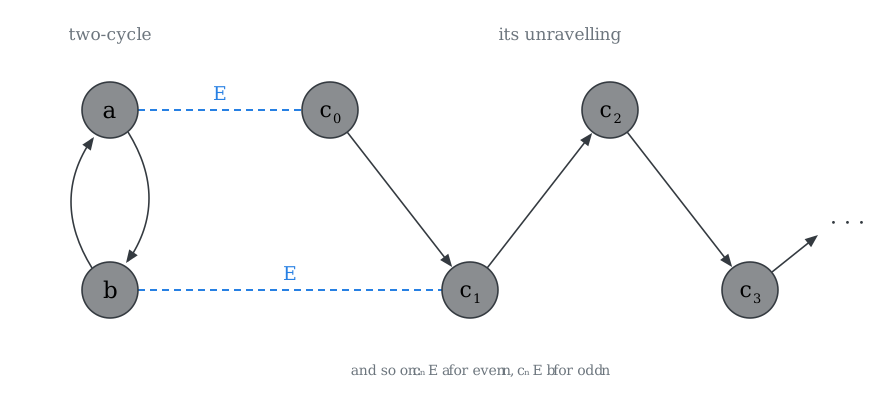
Given a model \((\{a, b\}, \{(a, b), (b, a)\}, V)\), consider a model based on \((\mathbb{N}, S)\) where for each atom \(p\):
\[ V'(p) = \{n \in \mathbb{N}: (a \in V(p) \ \text{and} \ n \ \text{even}) \ \text{or} \ (n \in V(p) \ \text{and} \ n \ \text{odd}) \} \] \(E = \{(a, n): n \ \text{even}\} \cup \{(b, n): n \ \text{odd}\}\)