PHIL 452 · Modal Logic
\(\Sigma\) characterizes a class of frames \(\mathcal{C}\) iff \(\Sigma\) is sound and complete with respect to \(\mathcal{C}\): \[\vdash_\Sigma \varphi \quad \text{iff} \quad \models_{\mathcal{C}} \varphi\]
\(\Sigma\) is sound with respect to \(\mathcal{C}\):
\[\vdash_\Sigma \varphi \quad \text{only if} \quad \models_{\mathcal{C}} \varphi\]
We argue that the axioms of \(\Sigma\) are valid in all frames in \(\mathcal{C}\).
We observe that both \(\textsf{MP}\) and \(\textsf{RN}\) preserve validity in all frames in \(\mathcal{C}\).
\(\Sigma\) is complete with respect to \(\mathcal{C}\):
\[\vdash_\Sigma \varphi \quad \text{if} \quad \models_{\mathcal{C}} \varphi\]
We argue by contraposition. If \(\nvdash_\Sigma \varphi\), then \(\varphi\) is not valid in all frames in \(\mathcal{C}\). That is, if \(\nvdash_\Sigma \varphi\), then we find a world at which \(\varphi\) fails in some model based on a frame in \(\mathcal{C}\).
We build the canonical model \(\mathcal{M}_\Sigma\) for \(\Sigma\) from maximal \(\Sigma\)-consistent sets of formulas.
We verify that the canonical for \(\Sigma\) is a member of the class \(\mathcal{C}\).
Each arrow will be justified in this deck:
\(\varphi\) is \(\Sigma\)-derivable from \(\Gamma\), written \(\Gamma \vdash_\Sigma \varphi\), iff there is a finite conjunction \(\boldsymbol{\alpha}\) of formulas \(\alpha_1, \dots, \alpha_n \in \Gamma\) for which \[\vdash_\Sigma \boldsymbol{\alpha} \to \varphi\]
We do not allow premises inside a derivation. Otherwise, \(\textsf{RN}\) would yield \(p \vdash_\Sigma \Box p\), which is undesirable.
\(\Gamma\) is \(\Sigma\)-consistent iff \(\Gamma \nvdash_\Sigma \bot\). In other words, there is no finite conjunction \(\boldsymbol{\alpha}\) of members of \(\Gamma\) for which \[\vdash_\Sigma \boldsymbol{\alpha} \to \bot\]
Otherwise, \(\Gamma\) is \(\Sigma\)-inconsistent.
\(\varphi\) is \(\Sigma\)-consistent iff \(\{\varphi\}\) is. That is, \(\varphi\) is \(\Sigma\)-consistent iff \(\nvdash_\Sigma \varphi \to \bot\).
\(\Gamma \vdash_\Sigma \varphi\) iff \(\Gamma, \neg \varphi\) is \(\Sigma\)-inconsistent.
Proof. We consider each direction in turn:
(\(\Rightarrow\)) Given a finite conjunction \(\boldsymbol{\alpha}\) of members of \(\Gamma\), if \(\vdash_\Sigma \boldsymbol{\alpha} \to \varphi\), then, since \(\vdash_\Sigma (\boldsymbol{\alpha} \wedge \neg \varphi) \to \neg \varphi\) and \(\vdash_\Sigma (\boldsymbol{\alpha} \wedge \neg \varphi) \to \varphi\), by \(\textsf{PL}\), \(\vdash_\Sigma (\boldsymbol{\alpha} \wedge \neg \varphi) \to \bot\). Therefore, \(\Gamma, \neg\varphi\) is \(\Sigma\)-inconsistent.
(\(\Leftarrow\)) Suppose \(\vdash_\Sigma (\boldsymbol{\alpha} \wedge \neg \varphi) \to \bot\) for some conjunction \(\boldsymbol{\alpha}\) of members of \(\Gamma\). Since \(\vdash_\Sigma \neg \bot\), by \(\textsf{PL}\), we have \(\vdash_\Sigma \neg(\boldsymbol{\alpha} \wedge \neg \varphi)\), whence \(\vdash_\Sigma \boldsymbol{\alpha} \to \varphi\) by \(\textsf{PL}\). Thus \(\Gamma \vdash_\Sigma \varphi\).
In particular, \(\nvdash_\Sigma \varphi\) iff \(\neg \varphi\) is \(\Sigma\)-consistent.
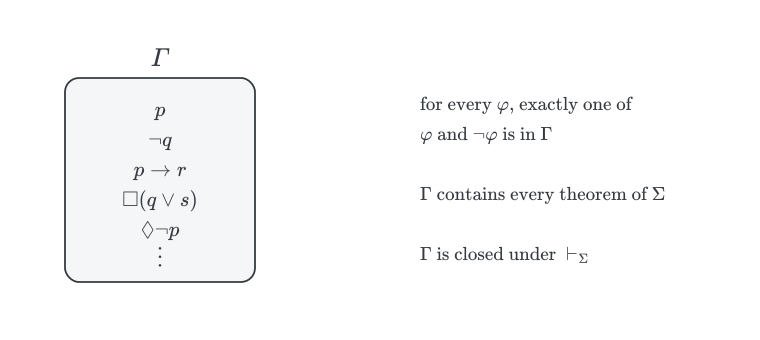
\(\Gamma\) is maximal \(\Sigma\)-consistent iff
(Lindenbaum theorem) If \(\Delta\) is \(\Sigma\)-consistent set, then \(\Delta\) is a subset of some maximal \(\Sigma\)-consistent set \(\Gamma\).
Proof. Enumerate all modal formulas:
\[ \varphi_0, \varphi_1, \varphi_2, \dots \] and build a chain:
\[ \Gamma = \Delta_0 \subseteq \Delta_1 \subseteq \Delta_2 \subseteq \cdots \] where \(\Delta_{0}\) is \(\Gamma\) and \(\Delta_{n+1}\) is \(\Delta_n, \varphi_n\) if that set is \(\Sigma\)-consistent, and \(\Delta_n\) otherwise.
Let \(\Delta = \bigcup_n \Delta_n\). Notice that the identity of \(\Delta\) is very sensitive to the details of the enumeration.
A maximal \(\Sigma\)-consistent set gives a complete and consistent description of a way the world might be. These will be the worlds of the canonical model for \(\Sigma\).
If \(\Gamma\) is maximal \(\Sigma\)-consistent, then
\[ \begin{array}{llll} 1. & \Gamma \vdash_\Sigma \varphi & \text{iff} & \varphi \in \Gamma \\ 2. & \neg \varphi \in \Gamma & \text{iff} & \varphi \notin \Gamma\\ 3. & \varphi \to \psi \in \Gamma & \text{iff} & \varphi \notin \Gamma \ \text{or} \ \psi \in \Gamma \\ \end{array} \]
Proof. We look at each case in turn:
(\(\Rightarrow\)) If \(\Gamma \vdash_\Sigma \varphi\), then \(\Gamma, \neg\varphi\) is \(\Sigma\)-inconsistent. If \(\varphi \notin \Gamma\), then, by maximal \(\Sigma\)-consistency, \(\Gamma, \varphi\) is \(\Sigma\)-inconsistent. But if both \(\Gamma, \varphi\) and \(\Gamma, \neg \varphi\) are \(\Sigma\)-inconsistent, \(\Gamma\) alone must be, contrary to assumption.
(\(\Leftarrow\)) Since \(\vdash_\Sigma \varphi \to \varphi\).
\(\neg \varphi \in \Gamma \Leftrightarrow \varphi \notin \Gamma\)
(\(\Rightarrow\)) If \(\neg \varphi \in \Gamma\), then \(\Gamma \vdash_\Sigma \neg\varphi\), so \(\varphi \notin \Gamma\) by consistency.
(\(\Leftarrow\)) If \(\varphi \notin \Gamma\), then \(\Gamma, \neg\neg\varphi\) is \(\Sigma\)-inconsistent, and thus \(\Gamma \vdash_\Sigma \neg \varphi\) by Theorem 8.1.
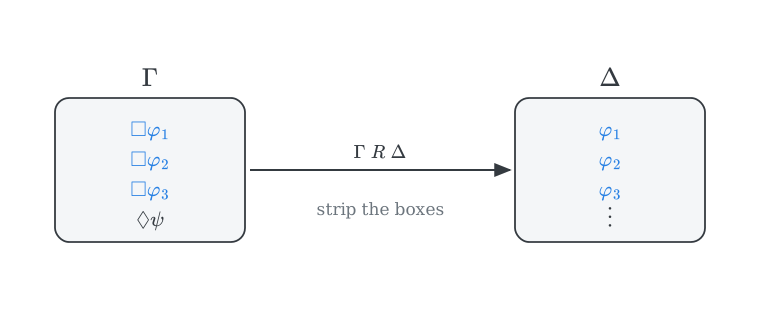
For maximal \(\Sigma\)-consistent \(\Gamma, \Delta\): \[\Gamma R \Delta \quad \text{iff} \quad \{\varphi : \Box \varphi \in \Gamma\} \subseteq \Delta\]
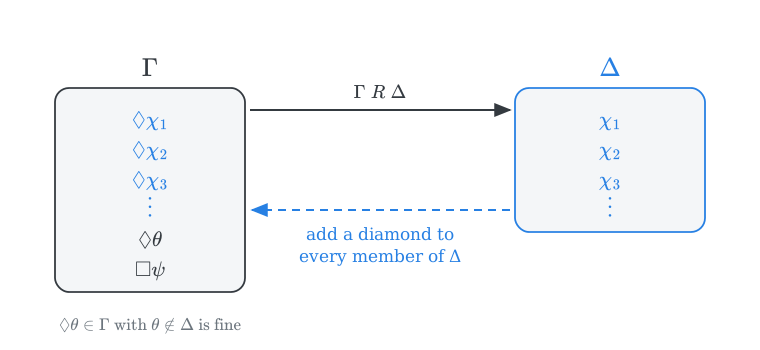
\(\{\Diamond \varphi : \varphi \in \Delta\} \subseteq \Gamma\) iff \(\{\varphi : \Box \varphi \in \Gamma\} \subseteq \Delta\)
Proof. We look at each direction in turn:
(\(\Rightarrow\)) Suppose \(\{\Diamond \varphi : \varphi \in \Delta\} \subseteq \Gamma\) and \(\Box \varphi \in \Gamma\). For reductio, suppose \(\varphi \notin \Delta\). Then \(\neg \varphi \in \Delta\), so \(\Diamond \neg \varphi \in \Gamma\), i.e., \(\neg \Box \neg\neg \varphi \in \Gamma\). Since \(\vdash_\Sigma \neg \Box \neg \neg \varphi \leftrightarrow \neg \Box \varphi\), we have \(\neg \Box \varphi \in \Gamma\), and so \(\Box \varphi \notin \Gamma\). Contradiction.
(\(\Leftarrow\)) Suppose \(\{\varphi : \Box \varphi \in \Gamma\} \subseteq \Delta\). We now argue for the conditional: if \(\Diamond \varphi \notin \Gamma\), then \(\varphi \notin \Delta\). If \(\neg \Box \neg \varphi \notin \Gamma\), then \(\Box \neg \varphi \in \Gamma\) by maximality. So \(\neg \varphi \in \Delta\), and \(\varphi \notin \Delta\).
If \(\Gamma\) is maximal \(\Sigma\)-consistent, then
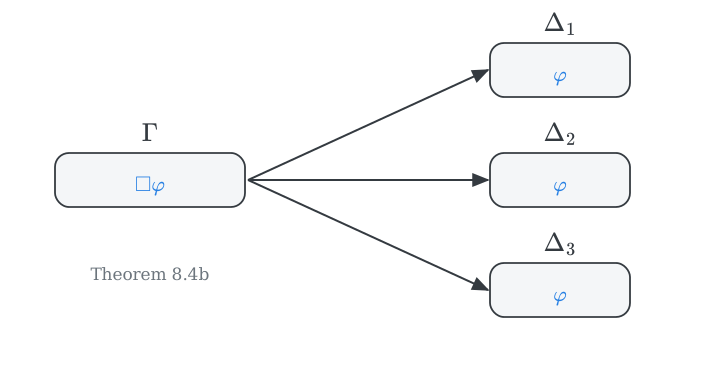
\[ \begin{array}{llll} \text{a.} & \Diamond \varphi \in \Gamma & \text{iff} & \text{for some max $\Sigma$-con} \ \Delta, \ \Gamma R \Delta \ \text{and} \ \varphi \in \Delta\\ \text{b.} & \Box \varphi \in \Gamma & \text{iff} & \text{for every max $\Sigma$-con} \ \Delta, \ \text{if} \ \Gamma R \Delta, \ \text{then} \ \varphi \in \Delta \end{array} \]
Part (b) will follow from (a) by duality.
Focus on (a) for now:
\((\Leftarrow)\) is immediate from the definition of \(R\).
\((\Rightarrow)\) is the existence lemma.
Plan. If \(\Diamond \varphi \in \Gamma\), we set out build an accessible \(\Delta\) that contains \(\varphi\). We need only check that the following set is \(\Sigma\)-consistent:
\[ \{\varphi\} \cup \{\psi : \Box\psi \in \Gamma\} \]
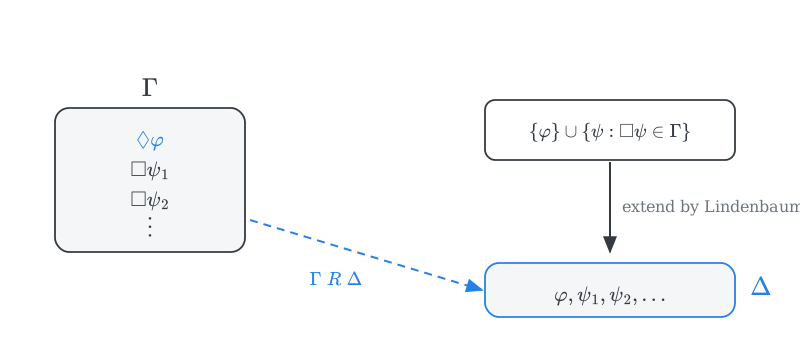
If a maximal \(\Sigma\)-consistent set \(\Delta\) extends \(\{\psi : \Box \psi \in \Gamma\}\), then it is accessible from \(\Gamma\).
If \(\Gamma\) is maximal \(\Sigma\)-consistent and \(\Diamond \varphi \in \Gamma\), then \(\{\varphi\} \cup \{\psi : \Box\psi \in \Gamma\}\) is \(\Sigma\)-consistent.
Proof. Suppose not. Then for some \(\Box\psi_1, \dots, \Box\psi_n \in \Gamma\):
\[ \begin{array}{lll} 1 & \vdash_\Sigma \varphi \wedge (\psi_1 \wedge \dots \wedge \psi_n) \to \bot & \\ 2 & \vdash_\Sigma (\psi_1 \wedge \dots \wedge \psi_n) \to \neg \varphi & \textsf{PL} \ 1\\ 3 & \vdash_\Sigma (\Box\psi_1 \wedge \dots \wedge \Box\psi_n) \to \Box \neg \varphi & \text{normality} \ 2\\ 4 & (\Box\psi_1 \wedge \dots \wedge \Box\psi_n) \to \Box \neg \varphi \in \Gamma & \Gamma \ \text{contains theorems}\\ 5 & \Box\psi_1 \wedge \dots \wedge \Box\psi_n \in \Gamma & \text{closure}\\ 6 & \Box \neg \varphi \in \Gamma & 4, 5 \end{array} \]
But \(\Box \neg \varphi\) is equivalent to \(\neg \Diamond \varphi\), which contradicts \(\Diamond \varphi \in \Gamma\) given the \(\Sigma\)-consistency of \(\Gamma\). So the set is \(\Sigma\)-consistent.
By Lindenbaum lemma, we may extends the set to the required \(\Delta\).
The canonical model \(\mathcal{M}_\Sigma = (W_\Sigma, R_\Sigma, V_\Sigma)\) for \(\Sigma\):
The canonical frame for \(\Sigma\) is \((W_\Sigma, R_\Sigma)\).
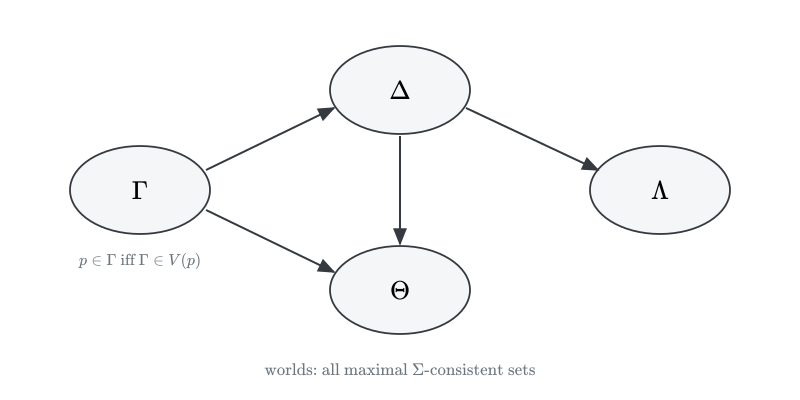
For each maximal \(\Sigma\)-consistent set \(\Gamma\) and each \(\varphi\): \[\mathcal{M}_\Sigma, \Gamma \Vdash \varphi \quad \text{iff} \quad \varphi \in \Gamma\]
Proof. By induction on the complexity of \(\varphi\): \[ \begin{array}{lllll} \text{Base case}: & & & & \\ &\mathcal{M}_\Sigma, \Gamma \Vdash p & \text{iff } & \Gamma \in V_\Sigma(p) & \\ & & \text{iff } & p \in \Sigma & \textsf{definition of} \ \Vdash \\[8pt] \text{Induction step for } \neg\textbf{:} & & & & \\ & \mathcal{M}_\Sigma, \Gamma \Vdash \neg \varphi & \text{iff } & \mathcal{M}_\Sigma, \Gamma \nVdash \varphi & \textsf{definition of} \ \Vdash \\ & & \text{iff } & \varphi \notin \Sigma & \textsf{inductive hypothesis} \\ & & \text{iff } & \neg \varphi \in \Sigma & \textsf{maximal consistency} \\[8pt] \text{Induction step for } \to\textbf{:} & \text{similar to $\neg$} & & & \\ %& \mathcal{M}_\Sigma, \Gamma \Vdash \varphi \to \psi & \text{iff } & \mathcal{M}_\Sigma, \Gamma \nVdash %\varphi \text{or} \ \mathcal{M}_\Sigma, \Gamma \Vdash \psi & \textsf{definition of} \ \Vdash \\ %& & \text{iff } & \varphi \notin \Sigma \ \text{or} \ \psi \in \Sigma & \textsf{inductive hypothesis} %\\ %& & \text{iff } & \varphi \to \psi \in \Sigma & \textsf{maximal consistency} \\ \end{array} \]
Proof. \[ \begin{array}{lllll} & \mathcal{M}_\Sigma, \Gamma \Vdash \Box \varphi & \text{iff } & \text{for all} \ \Delta \in W_\Sigma, \ \text{if} \ \Gamma R_\Sigma \Delta, \ \text{then} \ \mathcal{M}_\Sigma, \Delta \Vdash \varphi & \textsf{definition of} \ \Vdash \\ & & \text{iff} & \text{for all} \ \Delta \in W_\Sigma, \ \text{if} \ \Gamma R_\Sigma \Delta, \ \text{then} \ \varphi \in \Delta & \textsf{inductive hypothesis}\\ & & \text{iff} & \Box \varphi \in \Gamma & \textsf{Thm 8.4b}\\ \end{array} \]
If \(\nvdash_\Sigma \varphi\), then \(\varphi\) fails at some world of \(\mathcal{M}_\Sigma\).
So \(\Sigma\) is complete with respect to a class of frames \(\mathcal{C}\) if \(\mathcal{C}\) contains the canonical frame for \(\Sigma\).
\(\textsf{K}\) is complete with respect to the class of all frames.
Proof. The canonical frame for \(\textsf{K}\), \((W_\textsf{K}, W_\textsf{K})\), belongs to the class of all frames.
some open questions:
Is \(\textsf{KT}\) complete with respect to the class of reflexive frames?
Is the canonical frame for \(\textsf{KT}\), \((W_\textsf{KT}, W_\textsf{KT})\) a reflexive frame?
Is \(\textsf{KB}\) complete with respect to the class of symmetric frames?
Is the canonical frame for \(\textsf{KB}\), \((W_\textsf{KB}, W_\textsf{KB})\) a symmetric frame?