PHIL 452 · Modal Logic
Modal logic provides a formal approach to the study of different aspects of knowledge and its interaction with belief.
We follow Hintikka (1962) and supplement the language of propositional logic with a family of operators \(\textsf{K}_i\), one for each agent \(i \in I\).
\[ \begin{array}{lll} \textsf{K}_i \varphi & & \text{agent } i \text{ knows that } \varphi\\ \langle \textsf{K}_i \rangle \varphi & & \text{agent } i \text{ has not ruled out } \varphi\text{: for all } i \text{ knows, } \varphi \text{ might be the case} \end{array} \]
where \(\langle \textsf{K}_i \rangle\) abbreviates \(\neg \textsf{K}_i \neg\).
To know that \(\neg\varphi\) is to rule \(\varphi\) out.
To not know that \(\neg\varphi\) is to not rule \(\varphi\) out:
for all the agent \(i\) knows, \(\varphi\) might be true.
The content of someone’s knowledge of the world is given by his class of epistemically accessible worlds. These are the worlds that might, for all he knows, be his world; world \(w\) is one of them iff he knows nothing, either explicitly or implicitly, to rule out the hypothesis that \(w\) is the world where he lives. (Lewis 1986)
We speak of states rather than worlds:
A relational model \(M\) for \(\mathcal{L}^{\textsf{K}_i}\) is a structure \((W, \{R_i : i \in I\}, V)\), where:
\(W\) is a non-empty set of information states,
\(R_i\) is a binary accessibility relation on \(W\) for each \(i \in I\), and
\(V\) is a valuation that maps a propositional variable \(p\) to a set of states \(V(p)\).
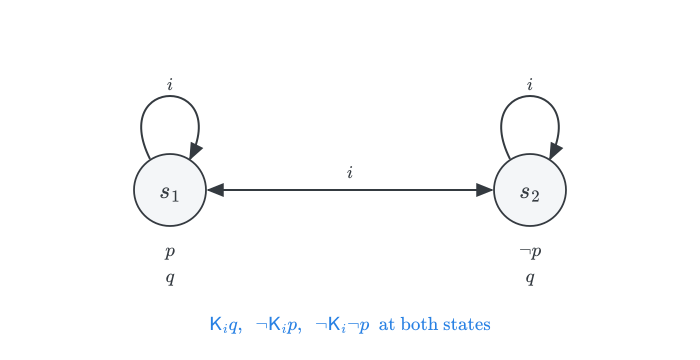
You have lost sight of your phone. Maybe it has been stolen (\(p\)) or maybe not (\(\neg p\)). Either way, you know you had it with you last night (\(q\)). You had your phone with you in all epistemic alternatives, but only one state encodes the information that your phone has been stolen.
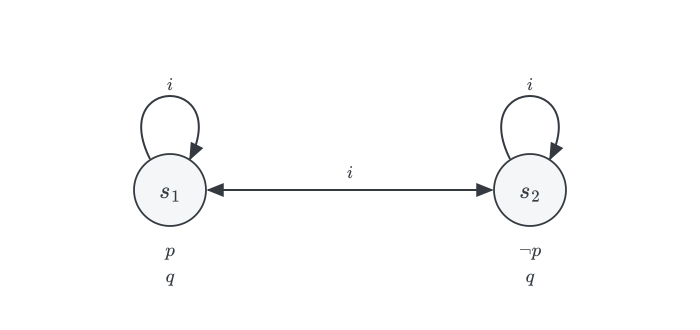
Nothing you know at either state enables you to distinguish \(s_1\) from \(s_2\). They are both candidates to represent what is in fact the case.
\[ \begin{array}{lll} M, s \Vdash p & \text{iff} & s \in V(p)\\ M, s \Vdash \neg \varphi & \text{iff} & M, s \nVdash \varphi\\ M, s \Vdash \varphi \to \psi & \text{iff} & M, s \nVdash \varphi \ \text{or} \ M, s \Vdash \psi\\ M, s \Vdash \textsf{K}_i \varphi & \text{iff} & \text{for every} \ u \in W \ \text{s.t.} \ R_i su, \ M, u \Vdash \varphi \end{array} \]
Since \(\langle \textsf{K}_i \rangle\) is \(\neg \textsf{K}_i \neg\):
\[ \begin{array}{lll} M, s \Vdash \langle \textsf{K}_i \rangle \varphi & \text{iff} & \text{for some} \ u \in W \ \text{s.t.} \ R_i su, \ M, u \Vdash \varphi \end{array} \]
\(\textsf{K}_i q\) is true at both states.
neither \(\textsf{K}_i p\) nor \(\textsf{K}_i \neg p\) is true at either state.
\(\varphi\) is true in a model \(M\), written \(M \Vdash \varphi\), iff \(M, s \Vdash \varphi\), for each \(s \in W\).
\(\varphi\) is valid in a frame \(F = (W, \{R_i : i \in I\})\), written \(F \models \varphi\), iff \(M \Vdash \varphi\), for each model \(M\) based on the frame \(F\).
All substitution instances of \(\textsf{K}\) are valid in all frames, and \(\textsf{RN}\) preserves validity in all frames:
\[\varphi / \textsf{K}_i \varphi \tag{\textsf{RN}}\] \[\textsf{K}_i (p \to q) \to (\textsf{K}_i p \to \textsf{K}_i q) \tag{\textsf{K}}\]
Agents know all logical truths, and they furthermore know what follows from what they know.
\[\textsf{K}_i (\varphi \wedge \psi) \to (\textsf{K}_i \varphi \wedge \textsf{K}_i \psi) \tag{\textsf{M}}\]
It follows from \(\textsf{RN}\) and \(\textsf{K}\): you know a conjunction iff you know each conjunct.
Semantically, \(\varphi \wedge \psi\) is true at a state iff \(\varphi\) and \(\psi\) both are.
Ordinary knowledge appears not to be closed under logical consequence, and ordinary agents do not know all logical truths. Many logical truths are far too complex for me to even entertain, much less know.
Two potential lines of response:
idealization: do not take \(\textsf{K}_i\) to represent ordinary knowledge. Instead, \(\textsf{K}_i\) is used to model the knowledge of idealized agents with unlimited logical capabilities.
implicit knowledge: use \(\textsf{K}_i\) to model what follows from knowledge we may reasonably attribute to ordinary agents, even if it is not explicitly known by them.
Which modal axioms are candidates for the logic of knowledge?
\[\textsf{K}_i p \to p \tag{\textsf{T}}\]
knowledge entails truth
\(\textsf{T}\) requires each \(R_i\) to be reflexive on \(W\).
each state is a genuine epistemic option for an agent at that very state.
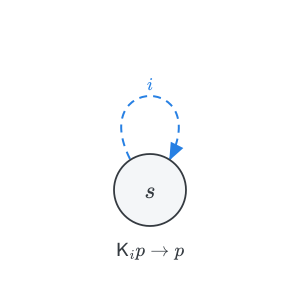
Consider the sentence ‘you do not know it, but your phone has been stolen’. \[p \wedge \neg \textsf{K}_i p\] This Moorean sentence may well be true, but could you ever come to know it?
Not in the presence of \(\textsf{T}\) and \(\textsf{M}\):
\(p \wedge \neg \textsf{K}_i p\) is falsified at all states of all reflexive models.
\(\neg (p \wedge \neg \textsf{K}_i p)\) is valid in all reflexive frames.
\(\vdash \neg \textsf{K}_i (p \wedge \neg \textsf{K}_i p)\)
Proof. We use instances of \(\textsf{M}\) and \(\textsf{T}\): \[ \begin{array}{lll} 1 & \textsf{K}_i (p \wedge \neg \textsf{K}_i p) \to (\textsf{K}_i p \wedge \textsf{K}_i \neg \textsf{K}_i p) & \textsf{M}\\ 2 & \textsf{K}_i \neg \textsf{K}_i p \to \neg \textsf{K}_i p & \textsf{T}\\ 3 & (\textsf{K}_i p \wedge \textsf{K}_i \neg \textsf{K}_i p) \to (\textsf{K}_i p \wedge \neg \textsf{K}_i p) & \textsf{PL} \ 2\\ 4 & \neg \textsf{K}_i (p \wedge \neg \textsf{K}_i p) & \textsf{PL} \ 1, 3 \end{array} \]
The dual of \(\textsf{T}\) claims that if something is true, then for all you know, it is true.
\[p \to \langle \textsf{K}_i \rangle p \] \(\textsf{B}\) claims that if something is true, then you know that for all you know, it might be true.
\[p \to \textsf{K}_i \langle \textsf{K}_i \rangle p \tag{\textsf{B}}\]
The dual claims that if for all you know, you might know something, then it is true. \[\langle \textsf{K}_i \rangle \textsf{K}_i p \to p \tag{$\textsf{B}_\Diamond$}\]
Whatever might be known is true. If for all you know, you might know that your phone has been stolen, then it has indeed been stolen.
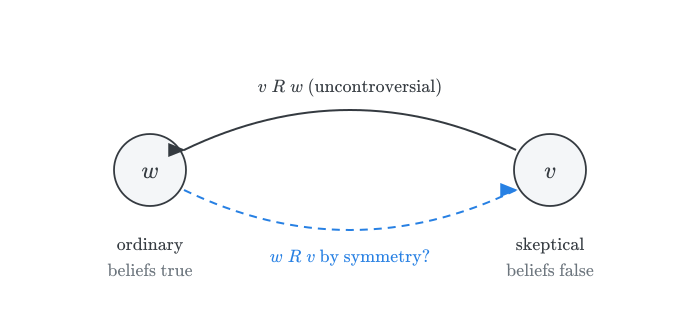
\(\textsf{B}\) requires each \(R_i\) to be symmetric on \(W\).
Williamson (2000, §8.2) links symmetry and to radical skepticism.
At \(w\), \(i\) believes that she has a hand.
At \(v\), \(i\) is systematically deceived into believing that despite being a brain in a vat.
\(R_ivw\). What \(i\) knows at \(v\) is true at \(w\).
By symmetry, \(R_i w v\), and what \(i\) knows at \(w\) is true at \(v\).
The belief that \(i\) has hand is false at \(v\), and it is not knowledge at \(w\).
Read as \(\neg \varphi \to \textsf{K}_i \neg \textsf{K}_i \varphi\):
whenever you fail to know something (maybe because it is false), you know that you do not know it.
The agent in \(v\) does not know she is being deceived; she does not know she does not know.
the rejection of \(\textsf{B}\) as a validity is not to say that symmetric models are never appropriate, as in the phone example.
If \(R_i\) is reflexive and euclidean on \(W\), then \(R_i\) is symmetric on \(W\).
\(\textsf{KTB} \sqsubseteq \textsf{KT5} = \textsf{S5}\).
The case against \(\textsf{B}\) is a case against \(\textsf{5}\).
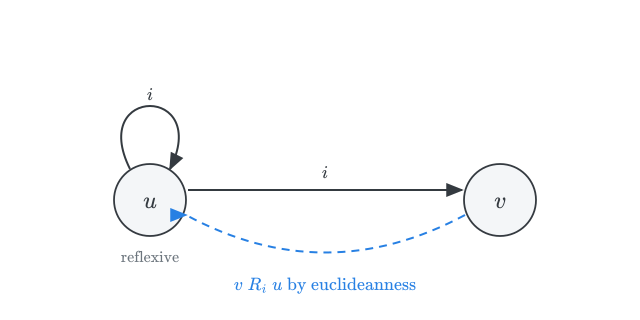
\[\langle \textsf{K}_i \rangle p \to \textsf{K}_i \langle \textsf{K}_i \rangle p \tag{\textsf{5}}\]
The dual axiom claims that if it is not ruled out that you know something, then you know it. \[\langle \textsf{K}_i \rangle \textsf{K}_i p \to \textsf{K}_i p \tag{$\textsf{5}_\Diamond$}\]
I mistakenly take myself to know that my phone has been stolen. Unbeknownst to me, I just misplaced it. So, I do not know that it has been stolen. Yet, since I have not ruled out that I know it, by \(\textsf{5}_\Diamond\), I must know it after all.
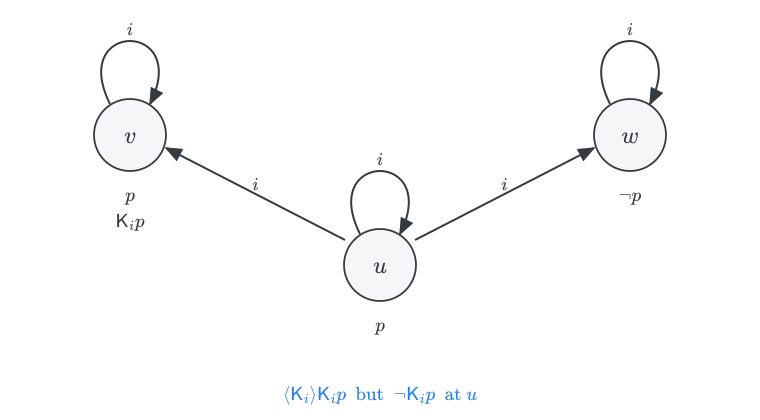
Add a belief operator \(\textsf{B}_i\) governed by at least two principles:
\[ \begin{array}{lll} \textsf{K}_i \varphi \to \textsf{B}_i \varphi & & \textsf{Knowledge entails Belief}\\ \textsf{B}_i \varphi \to \neg \textsf{B}_i \neg \varphi & & \textsf{Consistent Belief} \end{array} \]
Then \(\textsf{5}\) yields \[ \begin{array}{lll} \textsf{B}_i \textsf{K}_i \varphi \to \textsf{K}_i \varphi & & \textsf{Infallible Epistemic Belief} \\ \end{array} \]
Proof. We combine \(\textsf{5}\) with the two former principles: \[ \begin{array}{lll} 1 & \neg \textsf{K}_i \varphi \to \textsf{K}_i \neg \textsf{K}_i \varphi & \textsf{5} \ \text{in the form } \neg\textsf{K}_i \to \textsf{K}_i \neg \textsf{K}_i\\ 2 & \textsf{K}_i \neg \textsf{K}_i \varphi \to \textsf{B}_i \neg \textsf{K}_i \varphi & \textsf{Knowledge Entails Belief}\\ 3 & \textsf{B}_i \neg \textsf{K}_i \varphi \to \neg \textsf{B}_i \textsf{K}_i \varphi & \textsf{Consistent Belief} \ \text{for} \ \textsf{B}_i\\ 4 & \textsf{B}_i \textsf{K}_i \varphi \to \textsf{K}_i \varphi & \textsf{PL} \ 1, 2, 3 \end{array} \]
To believe that you know is, on this framework, sufficient to know. No one mistakenly believes that they know what they do not know.
\[\textsf{K}_i p \to \textsf{K}_i \textsf{K}_i p \tag{\textsf{4}}\]
Otherwise known as the \(\textsf{KK}\)-principle.
Knowledge is transparent to the agent.
Agents with unlimited introspection recognize their own knowledge: they have conclusive reasons that are not defeasible by new information.
\(\textsf{4}\) requires each \(R_i\) to be transitive on \(W\).
Hintikka (1962) adopted \(\textsf{KT4}\) (or \(\textsf{S4}\)) after dismissing \(\textsf{B}\) and \(\textsf{5}\) as implausible.
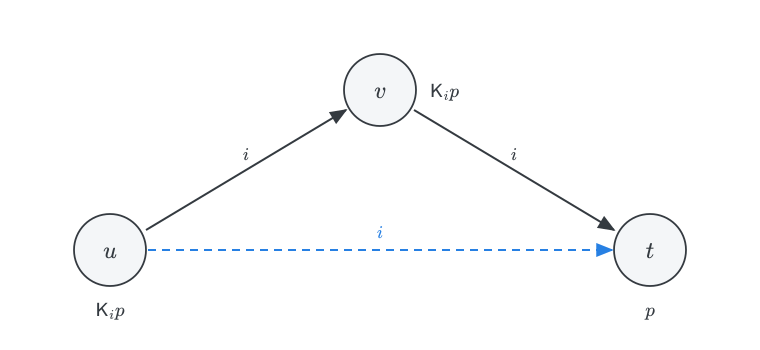
Given \(\textsf{K}_i \varphi \to \textsf{B}_i \varphi\), axiom \(\textsf{4}\) entails \[\textsf{K}_i \varphi \to \textsf{B}_i \textsf{K}_i \varphi\]
Proof. We need only assume that Knowledge entails Belief. \[ \begin{array}{lll} 1 & \textsf{K}_i \varphi \to \textsf{K}_i \textsf{K}_i \varphi & \textsf{4}\\ 2 & \textsf{K}_i \textsf{K}_i \varphi \to \textsf{B}_i \textsf{K}_i \varphi & \textsf{Knowledge entails Belief}\\ 3 & \textsf{K}_i \varphi \to \textsf{B}_i \textsf{K}_i \varphi & \textsf{PL} \ 1, 2 \end{array} \]
I know something only if I believe that I know it.
Williamson (2000, ch. 5): you glance at a crowd and make an estimate. Let \(p_k\) stand for the proposition that the actual count is \(k\).
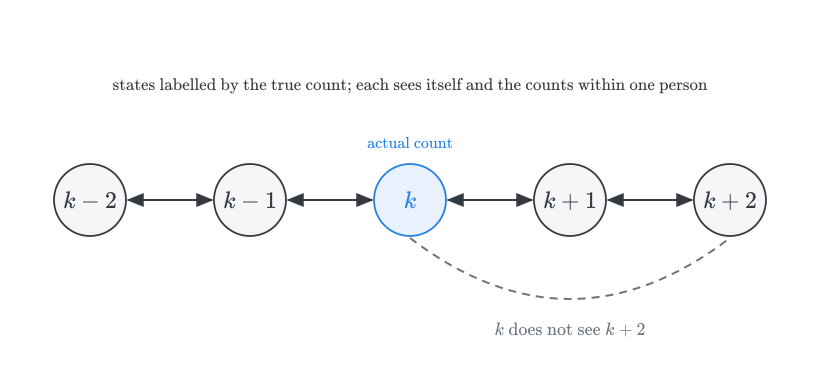
A margin of error principle: \[\textsf{K} \neg p_k \to \neg p_{k+1} \tag{\textsf{MEP}}\] You know the count is not \(k\) only if it is not \(k+1\) either. This is because you cannot distinguish two crowds that differ just by one person. So, your belief would be true only by luck.
Suppose the true count is \(k+1\) and you believe it is not \(k\).
A crowd of \(k\) would look exactly the same to you as this crowd.
You would have formed the same belief had the count been \(k\), and it would have been false.
Your belief is true only by luck, and a belief that is true by luck is not knowledge.
Suppose you are reflective enough to know every instance of \(\textsf{MEP}\).
Proof. You know that the count is not \(k\) only if you know that it is not \(k+1\). \[ \begin{array}{lll} 1 & \textsf{K} \neg p_k \to \textsf{K} \textsf{K} \neg p_k & \textsf{4}\\ 2 & \textsf{K}(\textsf{K} \neg p_k \to \neg p_{k+1}) & \text{known instance of } \textsf{MEP}\\ 3 & \textsf{K} \textsf{K} \neg p_k \to \textsf{K} \neg p_{k+1} & \textsf{K}, \ 2\\ 4 & \textsf{K} \neg p_k \to \textsf{K} \neg p_{k+1} & \textsf{PL} \ 1, 3 \end{array} \]
You surely know the count is not \(0\): \(\textsf{K} \neg p_0\).
By induction, \(\textsf{K} \neg p_n\) for every \(n\), including the true count \(k\).
By \(\textsf{T}\), \(\neg p_k\), contradicting \(p_k\).
Williamson blames \(\textsf{4}\): limited discrimination calls for non-transitive accessibility.
\(\textsf{T}\): accepted by all.
\(\textsf{B}\), \(\textsf{5}\): rejected by most.
\(\textsf{4}\): contested.
Hintikka and Stalnaker support \(\textsf{S4}\).
Williamson stays with \(\textsf{KT}\).
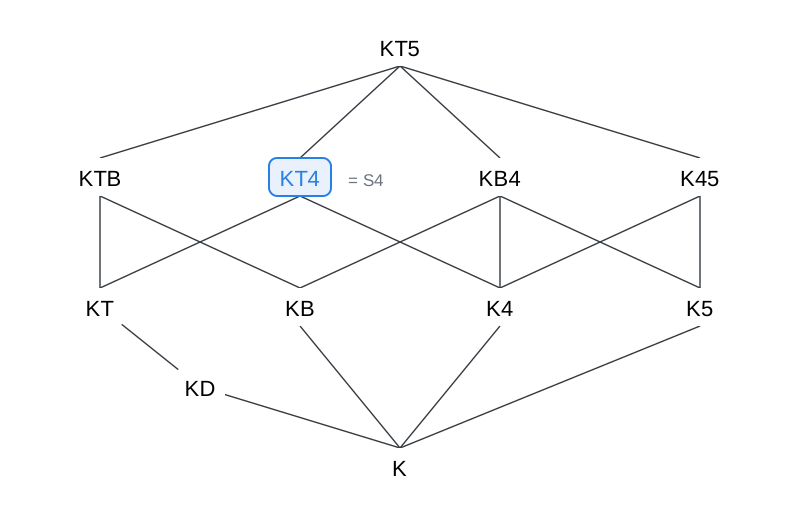
For a survey of these debates, see Holliday, “Epistemic Logic and Epistemology” (2018), §7.
Margin of error principles reappear in a famous paradox.
Teacher announces an exam next term that will come as a surprise: on the day of the exam, students will not know that it is that day.
The exam cannot be on the last day.
Otherwise, students would know that it is that day.
Having ruled out the last day, it cannot be on the penultimate day either.
If no exam has taken place by the penultimate day, it would be the only option left.
Similar reasoning rules out every other day, until no day is left.
Yet, teacher eventually gives the exam, and the students are surprised.
Williamson (2000, ch. 6): the same issue arises in a much simpler case.
Students know the teacher circles all and only exam dates on her office calendar.
From a distant glimpse, they see exactly one date circled. They are able to appreciate that it is not very near the end of term, but they cannot narrow it down much further.
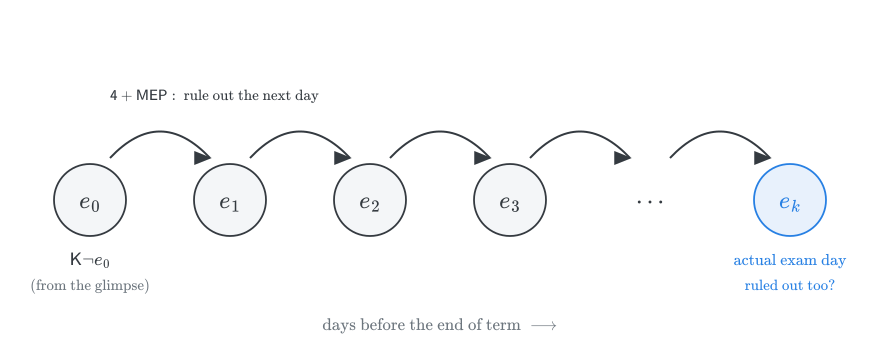
Let \(e_n\): the exam takes place \(n\) days before the end of term.
Since the glimpse is imprecise, a margin of error principle applies, and the students know it:
\[\textsf{K} \neg e_n \to \neg e_{n+1} \tag{\textsf{MEP}}\]
From the glimpse, they know the exam is not on the last day: \(\textsf{K} \neg e_0\).
Proof. If students can rule out \(e_{0}\), then they can rule out \(e_{1}\): \[ \begin{array}{lll} 1 & \textsf{K} \neg e_0 \to \textsf{K} \textsf{K} \neg e_0 & \textsf{4}\\ 2 & \textsf{K}(\textsf{K} \neg e_0 \to \neg e_1) & \text{known instance of } \textsf{MEP}\\ 3 & \textsf{K} \textsf{K} \neg e_0 \to \textsf{K} \neg e_1 & \textsf{K}, \ 2\\ 4 & \textsf{K} \neg e_0 \to \textsf{K} \neg e_1 & \textsf{PL} \ 1, 3 \end{array} \]
In general: \[\textsf{K} \neg e_n \to \textsf{K} \neg e_{n+1}\]
Students start from \(\textsf{K} \neg e_0\) and they are in a position to rule out every day of term.
Yet, the exam takes place and they are surprised.
For Williamson, the students’ error is to rely on \(\textsf{4}\).
Of special interest is the interaction of epistemic and metaphysical modalities.
Some philosophers hold that what is true never outstrips what can be known. If we read \(\Diamond\) in terms of metaphysical possibility, the knowability principle becomes: \[p \to \Diamond \textsf{K} p \tag{\textsf{Knowability}}\]
Fitch’s paradox. Knowability, given modest principles, entails that every truth is known: \[p \to \textsf{K} p \tag{\textsf{Knowledge}}\]
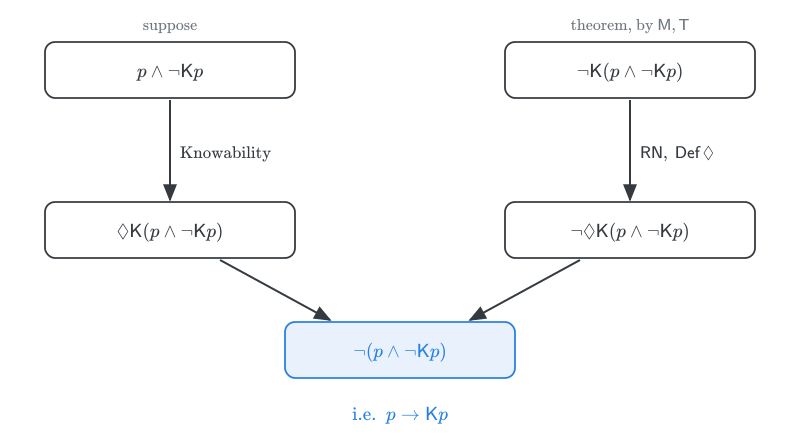
If \(\textsf{Knowledge}\) fails, then there are Moorean truths. The thought is to apply Knowability to a Moorean truth. If, unbeknownst to you, your phone has been stolen, then \(p \wedge \neg \textsf{K} p\) is an ordinary truth you could never come to know: as soon as you know \(p\), the second conjunct becomes false. So, if \(\textsf{Knowledge}\) fails, \(\textsf{Knowability}\) must fail as well.
For \(\textsf{K}\): \(\textsf{M}\) and \(\textsf{T}\), which gave us the theorem \(\neg \textsf{K}(p \wedge \neg \textsf{K}p)\).
For \(\Box\): the rule \(\textsf{RN}\), and \(\Diamond\) as the dual of \(\Box\).
A simple instance of \(\textsf{Knowability}\) for a Moorean truth.
Classical propositional logic.
Notice how little is assumed: no \(\textsf{4}\), no \(\textsf{5}\), no full closure of knowledge.
Proof. Here is a formal version of the argument: \[ \begin{array}{lll} 1 & \textsf{K}(p \wedge \neg \textsf{K} p) \to (\textsf{K} p \wedge \textsf{K} \neg \textsf{K} p) & \textsf{M}\\ 2 & \textsf{K} \neg \textsf{K} p \to \neg \textsf{K} p & \textsf{T}\\ 3 & \neg \textsf{K}(p \wedge \neg \textsf{K} p) & \textsf{PL} \ 1, 2\\ \hline 4 & \Box \neg \textsf{K}(p \wedge \neg \textsf{K} p) & \textsf{RN} \ 3\\ 5 & \neg \Diamond \textsf{K}(p \wedge \neg \textsf{K} p) & \textsf{Def} \ \Diamond \ 4\\ \hline 6 & (p \wedge \neg \textsf{K} p) \to \Diamond \textsf{K}(p \wedge \neg \textsf{K} p) & \textsf{Knowability}\\ 7 & p \to \textsf{K} p & \textsf{PL} \ 5, 6 \end{array} \]
Three stages: Moorean truths are unknowable (1–3); as a matter of necessity (4–5); and thus \(\textsf{Knowability}\) collapses into \(p \to \textsf{K}p\) (6–7).
If all truths are knowable, all truths are known.
Making the agent explicit again, a model for the hybrid language requires two accessibility relations: \(R_i\) for \(i\)’s knowledge and \(R_\Diamond\) for metaphysical possibility.
RN in line 4 presupposes that line 3 is true at every \(R_\Diamond\)-accessible world. Since line 3 depends on \(\textsf{T}\), \(R_i\) must be reflexive at every world.
\(\Diamond\) shifts the world of evaluation, including for the inner \(\neg \textsf{K}_i p\).
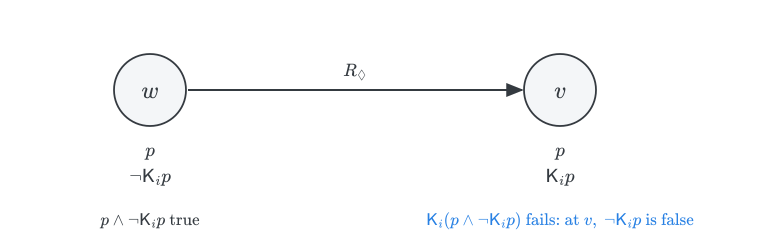
For \(\textsf{Knowability}\) to be true at \(w\), \(\textsf{K}_i(p \wedge \neg \textsf{K}_i p)\) must be true at some \(R_\Diamond\)-accessible world.
To know the conjunction requires one to know \(p\): it must be a world like \(v\), where \(i\) knows \(p\).
But at \(v\), the second conjunct says that \(i\) does not know \(p\) at \(v\), not at \(w\). Since knowledge is factive, \(i\) cannot know the conjunction at \(v\).
What we want is a world where \(i\) knows \(p\) and knows she did not know \(p\) at \(w\).
\(\textsf{K}_i(p \wedge \neg \textsf{K}_i p)\) cannot express this: the inner \(\textsf{K}_i\) concerns \(i\)’s state at the world of evaluation.
On this view, the paradox arises because some truths concern the agent’s own epistemic situation, and coming to know them makes them false.
Logic: the final step to \(p \to \textsf{K}p\) is not intuitionistically valid. Some anti-realists reject classical logic.
Restriction (Tennant): restrict Knowability to Cartesian truths, those \(\varphi\) for which \(\textsf{K}\varphi\) is consistent. Since \(\textsf{K}(p \wedge \neg \textsf{K}p)\) is inconsistent by \(\textsf{M}\) and \(\textsf{T}\), the instance in line 6 is blocked.
Interpretation (van Benthem): read \(\Diamond \textsf{K}\varphi\) dynamically, as one could come to know \(\varphi\) by learning something true. Learning \(p \wedge \neg \textsf{K}p\) makes it false.
We will return to this idea when we discuss information flow.