frames

PHIL 452 ยท Modal Logic

Gabriel Uzquiano

frame validity

One reason to explore frames is the correspondence between the validity of certain modal principles and structural conditions on accessibility.

frames

A frame \(F\) for \(\mathcal{L}^\Box\) is an ordered pair \((W, R)\) where:

  • \(W\) is a non-empty set of worlds, and

  • \(R\) is a binary accessibility relation on \(W\)

A model \(M\) is based on a frame \(F = (W, R)\) iff \(M = (F, V)\) for some assignment \(V\).

That is, \(M\) is based on \((W, R)\) iff \(M = (W, R, V)\).

validity

A formula \(\varphi\) is valid in a frame \((W, R)\), written \((W, R) \models \varphi\), iff \(\varphi\) is true in every model \((W, R, V)\) based on the frame \((W, R)\).

That is, the formula remains true across models based on that frame: it is true no matter what sets of worlds we assign to the propositional variables.

A formula \(\varphi\) is valid, written \(\models \varphi\), iff \(\varphi\) is valid in every frame \((W, R)\).

example

Proposition 1 The formula \(\Box (p \to q) \to (\Box p \to \Box q)\) is valid in every frame.

Proof. Fix a frame \((W, R)\). \(\Box (p \to q) \to (\Box p \to \Box q)\) is true in every model \(M\) based on that frame.

Fix a valuation \(V\). \(\Box (p \to q) \to (\Box p \to \Box q)\) is true in \(M = (W, R, V)\).

Fix a world \(w\) in \(W\). \(\Box (p \to q) \to (\Box p \to \Box q)\) is true at \(w\) in \(M\).

Assume \(M, w \Vdash \Box (p \to q)\). We now argue that \(M, w \Vdash \Box p \to \Box q\). Assume \(M, w \Vdash \Box p\), and let \(u \in W\) be accessible from \(w\). Then \(M, u \Vdash p \to q\) and \(M, u \Vdash p\). So, \(M, u \Vdash q\). Generalizing, \(M, w \Vdash \Box q\) as required.

example

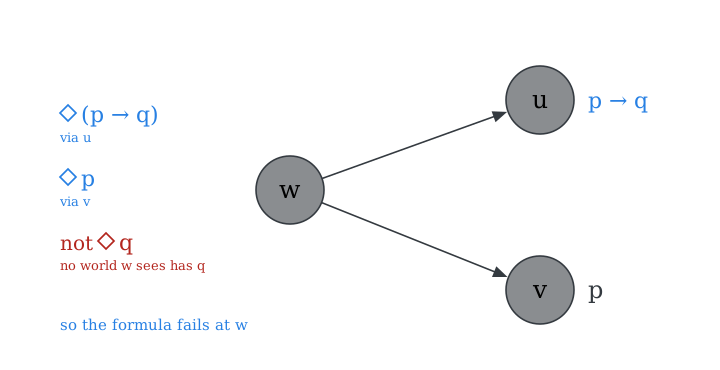
Proposition 2 The formula \(\Diamond (p \to q) \to (\Diamond p \to \Diamond q)\) is not valid in every frame.

Proof. Consider a frame \((W, R)\) where:

  • \(W = \{w, u, v\}\)
  • \(R = \{(w, u), (w, v)\}\)

Consider a valuation \(V\) such that \(V(p) = \{v\}\) and \(V(q) = \emptyset\).

Let \(M\) be \((W, R, V)\). Then:

  • \(M, w \Vdash \Diamond (p \to q)\), since \(Rwu\) and \(M, u \Vdash p \to q\).
  • \(M, w \Vdash \Diamond p\), since \(Rwv\) and \(M, v \Vdash q\).
  • \(M, w \nVdash \Diamond p\), since no world accessible from \(w\) verifies \(q\).
validity in a class of models

A formula \(\varphi\) is valid in a class of frames \(\mathcal{C}\), written \(\models_{\mathcal{C}} \varphi\) if, and only if, \(\varphi\) is valid in every frame \((W, R)\) in the class \(\mathcal{C}\).

Some important classes of frames:

\[ \begin{array}{lll} \mathcal{C}_{\textsf{ref}} & = & \{(W, R): R \ \text{is reflexive on} \ W\}\\ \mathcal{C}_{\textsf{sym}} & = & \{(W, R): R \ \text{is symmetric on} \ W\}\\ \mathcal{C}_{\textsf{trans}} & = & \{(W, R): R \ \text{is transitive on} \ W\}\\ \mathcal{C}_{\textsf{euc}} & = & \{(W, R): R \ \text{is euclidean on} \ W\}\\ \end{array} \]

example

Proposition 3 Each formula is valid in a frame if \(R\) satisfies the relevant condition.

Formula Condition on \(R\)
\(\textsf{T}\) \(\Box p \to p\) reflexive on \(W\)
\(\textsf{B}\) \(p \to \Box \Diamond p\) symmetric on \(W\)
\(\textsf{4}\) \(\Box p \to \Box \Box p\) transitive on \(W\)
\(\textsf{5}\) \(\Diamond p \to \Box \Diamond p\) euclidean on \(W\)

\(\textsf{T}\) is valid in reflexive frames

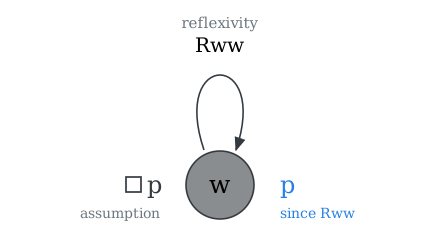
Proposition 4 \(\textsf{T}\) is valid in all reflexive frames.

Proof. Fix a reflexive frame \((W, R)\).

Argue \(\Box p \to p\) is true in every model \(M\) based on that frame.

Fix a valuation \(V\). Argue \(\Box p \to p\) is true in \(M = (W, R, V)\).

Fix a world \(w\) in \(W\). Argue \(\Box p \to p\) is true at \(w\) in \(M\).

Assume \(M, w \Vdash \Box p\). Since \(R\) is reflexive, \(Rww\), which means that \(M, w \Vdash p\).
\(\textsf{B}\) is valid in symmetric frames

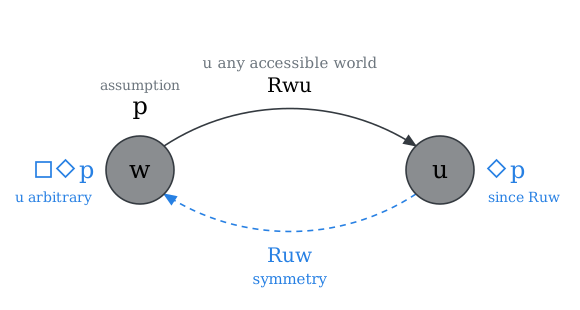
Proposition 5 \(\textsf{B}\) is valid in all symmetric frames.

Proof. Fix a symmetric frame \((W, R)\).

Argue \(p \to \Box \Diamond p\) is true in every model \(M\) based on that frame.

Fix a valuation \(V\). Argue \(p \to \Box \Diamond p\) is true in \(M = (W, R, V)\).

Fix a world \(w\) in \(W\). Argue \(p \to \Box \Diamond p\) is true at \(w\) in \(M\).

Assume \(M, w \Vdash p\). Argue that \(M, w \Vdash \Box \Diamond p\). If \(w\) sees \(u\), by symmetry, \(Ruw\). So, \(M, u \Vdash \Diamond p\). Generalizing, \(M, w \Vdash \Box \Diamond p\).
\(\textsf{4}\) is valid in transitive frames

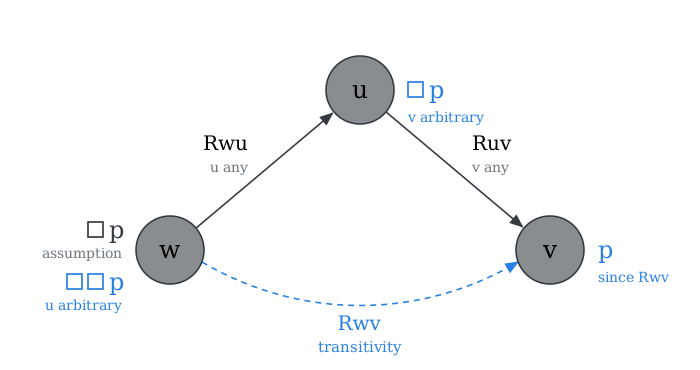
Proposition 6 \(\textsf{4}\) is valid in all transitive frames.

Proof. Fix a transitive frame \((W, R)\).

Argue \(\Box p \to \Box \Box p\) is true in every model \(M\) based on that frame.

Fix a valuation \(V\). Argue \(\Box p \to \Box \Box p\) is true in \(M = (W, R, V)\).

Fix a world \(w\) in \(W\). Argue \(\Box p \to \Box \Box p\) is true at \(w\) in \(M\).

Assume \(M, w \Vdash \Box p\). If \(w\) sees \(u\), then \(M, u \Vdash \Box p\). For if \(u\) sees \(v\), then since, by transitivity, \(w\) sees \(v\), \(M, v \Vdash p\). Generalizing, \(M, w \Vdash \Box \Box p\).
\(\textsf{5}\) is valid in euclidean frames

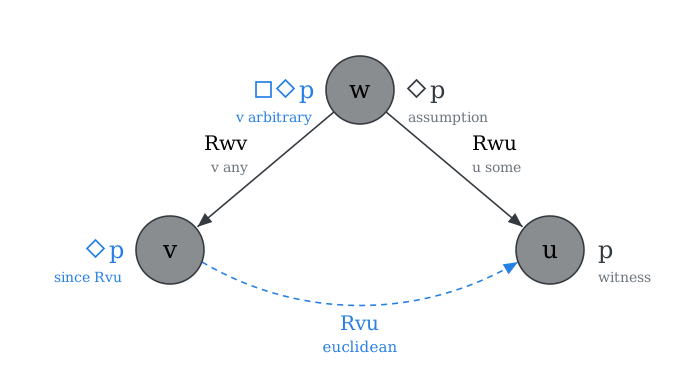
Proposition 7 \(\textsf{5}\) is valid in all euclidean frames.

Proof. Fix a euclidean frame \((W, R)\).

Argue \(\Diamond p \to \Box \Diamond p\) is true in every model \(M\) based on that frame.

Fix a valuation \(V\). Argue \(\Diamond p \to \Box \Diamond p\) is true in \(M = (W, R, V)\).

Fix a world \(w\) in \(W\). Argue \(\Diamond p \to \Box \Diamond p\) is true at \(w\) in \(M\).

Assume \(M, w \Vdash \Diamond p\). That is, \(w\) sees a world \(u\) such that \(M, u \Vdash p\). If \(w\) sees a world \(v\), then, since \(R\) is euclidean and \(Rwv\) and \(Rwu\), we have \(Rvu\). Therefore, \(M, v \Vdash \Diamond p\). Generalizing, \(M, v \Vdash \Box \Diamond p\).
frame definability

The success of the possible worlds framework is connected to the existence of systematic correspondences between the validity of certain modal principles and certain structural constraints on accessibility.

\(\textsf{T}\) is only valid in reflexive frames

Proposition 9 \(\textsf{T}\) is only valid in all reflexive frames.

Proof. Fix a frame \((W, R)\). If \((W, R) \models \textsf{T}\), then \(R\) is reflexive on \(W\). Suppose \((W, R) \models \Box p \to p\).

\(R\) is reflexive on \(W\). Fix a world \(w \in W\). Argue that \(Rww\).

Let \(V\) be such that \(V(p) = \{u\in W: Rwu\}\).

If \((W, R) \models \Box p \to p\), then \(M = (W, R, V) \Vdash \Box p \to p\). Therefore, \(M, w \Vdash \Box p \to p\).

By construction, \(M, w \Vdash \Box p\). Therefore, \(M, w \Vdash p\). It follows that \(w \in V(p) = \{u\in W: Rwu\}\) and \(Rww\).

Proof. Fix a frame \((W, R)\). If \(R\) is not reflexive on \(W\), then \((W, R) \not \models \textsf{T}\). Suppose \((W, R)\) is non-reflexive, that is, for some \(w \in W\), \(\neg Rww\).

\(\Box p \to p\) is not true in every model \(M\) based on \((W, R)\).

Let \(V\) be such that \(V(p) = W \setminus \{w\}\), where \(\neg Rww\).

\(\Box p \to p\) is not true in \(M = (W, R, V)\).

\(\Box p \to p\) is not true at \(w\) in \(M\).

  • \(M, w \Vdash \Box p\), since \(p\) is true at all other worlds.

  • \(M, w \nVdash p\), since \(w \notin V(p)\).

\(\textsf{B}\) is only valid in symmetric frames

Proposition 10 \(\textsf{B}\) is only valid in symmetric frames.

Proof. Fix a frame \((W, R)\). If \((W, R) \models \textsf{B}\), then \(R\) is symmetric on \(W\). Suppose \((W, R) \models p \to \Box \Diamond p\).

\(R\) is symmetric on \(W\). Fix worlds \(w, u \in W\) such that \(Rwu\). Argue that \(Ruw\).

Let \(V\) be such that \(V(p) = \{w\}\).

If \((W, R) \models p \to \Box \Diamond p\), then \(M = (W, R, V) \Vdash p \to \Box \Diamond p\). Therefore, \(M, w \Vdash p \to \Box \Diamond p\).

By construction, \(M, w \Vdash p\). Therefore, \(M, w \Vdash \Box \Diamond p\). Since \(Rwu\), \(M, u \Vdash \Diamond p\). But then \(Ruw\), since \(w\) is the only \(p\)-world in the model.

Proof. Fix a frame \((W, R)\). If \(R\) is not symmetric on \(W\), then \((W, R) \not \models \textsf{B}\). Suppose \((W, R)\) is non-symmetric, that is, for some \(w, u \in W\), \(Rwu\) but \(\neg Ruw\).

\(p \to \Box \Diamond p\) is not true in every model \(M\) based on \((W, R)\).

Let \(V\) be such that \(V(p) = \{w\}\), where for some \(u\in W\), \(Rwu\) but \(\neg Ruw\).

\(p \to \Box \Diamond p\) is not true in \(M = (W, R, V)\).

\(p \to \Box \Diamond p\) is not true at \(w\) in \(M\).

  • \(M, w \Vdash p\), since \(w \in V(p)\).

  • \(M, w \nVdash \Box \Diamond p\), since \(Rwu\) but \(M, u \nVdash \Diamond p\): \(\neg Ruw\), but \(w\) is the only \(p\)-world in the model.

\(\textsf{4}\) is only valid in transitive frames

Proposition 11 \(\textsf{4}\) is only valid in transitive frames.

Proof. Fix a frame \((W, R)\). If \((W, R) \models \textsf{4}\), then \(R\) is transitive on \(W\). Suppose \((W, R) \models p \to \Box \Diamond p\).

\(R\) is transitive on \(W\). Fix worlds \(w, u, v \in W\) such that \(Rwu\) and \(Ruv\). Argue that \(Ruv\).

Let \(V\) be such that \(V(p) = \{t\in W: Rwt\}\).

If \((W, R) \models \Box p \to \Box \Box p\), then \(M = (W, R, V) \Vdash \Box p \to \Box \Box p\). Therefore, \(M, w \Vdash \Box p \to \Box \Box p\).

By construction, \(M, w \Vdash \Box p\). Therefore, \(M, w \Vdash \Box \Box p\). Since \(Rwu\), \(M, u \Vdash \Box p\). But since \(Ruv\), \(M, v \Vdash p\), which means that \(v \in V(p) = \{t\in W: Rwt\}\). Therefore, \(Rwv\).

Proof. Fix a frame \((W, R)\). If \(R\) is not transitive on \(W\), then \((W, R) \not \models \textsf{4}\). Suppose \((W, R)\) is non-transitive, that is, there are \(w, u, v \in W\) such that \(Rwu\) and \(Ruv\) but \(\neg Rwv\).

\(\Box p \to \Box \Box p\) is not true in every model \(M\) based on \((W, R)\).

Let \(V\) be such that \(V(p) \{t\in W: Rwt\}\), where for some \(u, v\in W\), \(Rwu\) and \(Ruv\) but \(\neg Rwv\).

\(\Box p \to \Box \Box p\) is not true in \(M = (W, R, V)\).

\(\Box p \to \Box \Box p\) is not true at \(w\) in \(M\).

  • \(M, w \Vdash \Box p\), since \(V(p)\) contains every world accessible from \(w\).

  • \(M, w \nVdash \Box \Box p\), since \(Rwu\) but \(M, u \nVdash \Box p\): since \(\neg Rwv\), \(v\) is not a \(p\)-world accessible from \(u\).

\(\textsf{5}\) is only valid in euclidean frames

Proposition 12 \(\textsf{5}\) is only valid in euclidean frames.

Proof. Fix a frame \((W, R)\). If \((W, R) \models \textsf{5}\), then \(R\) is euclidean on \(W\). Suppose \((W, R) \models \Diamond p \to \Box \Diamond p\).

\(R\) is euclidean on \(W\). Fix worlds \(w, u, v \in W\) such that \(Rwu\) and \(Rwv\). Argue that \(Ruv\).

Let \(V\) be such that \(V(p) = \{v\}\).

If \((W, R) \models \Diamond p \to \Box \Diamond p\), then \(M = (W, R, V) \Vdash \Diamond p \to \Box \Diamond p\). Therefore, \(M, w \Vdash \Diamond p \to \Box \Diamond p\).

\(M, w \Vdash \Diamond p\), since \(Rwv\) and \(v\) is a \(p\)-world. Therefore, \(M, w \Vdash \Box \Diamond p\). Since \(Rwu\), \(M, u \Vdash \Diamond p\). But then \(Ruv\), since \(v\) is the only \(p\)-world in the model.

Proof. Fix a frame \((W, R)\). If \(R\) is not euclidean on \(W\), then \((W, R) \not \models \textsf{5}\). Suppose \((W, R)\) is non-euclidean, that is, for some \(w, u, v \in W\), \(Rwu\) and \(Rwv\) but \(\neg Ruv\)..

\(\Diamond p \to \Box \Diamond p\) is not true in every model \(M\) based on \((W, R)\).

Let \(V\) be such that \(V(p) = \{w\}\), where for some \(w, u, v\in W\), \(Rwu\) and \(Rwv\) but \(\neg Ruv\).

\(\Diamond p \to \Box \Diamond p\) is not true in \(M = (W, R, V)\).

\(\Diamond p \to \Box \Diamond p\) is not true at \(w\) in \(M\).

  • \(M, w \Vdash \Diamond p\), since \(Rwv\) and \(v \in V(p)\).

  • \(M, w \nVdash \Box \Diamond p\), since \(Rwu\) but \(M, u \nVdash \Diamond p\): \(\neg Ruv\), but \(v\) is the only \(p\)-world in the model.