completeness
PHIL 452 · Modal Logic
modal completeness beyond \(\textsf{K}\)

Consider the case of \(\textsf{KT}\). If \(\nvdash_{KT} \varphi\), then the argument above yields that there is some \(\Gamma \in W_{\textsf{KT}}\) for which \(\mathcal{M}_{\textsf{KT}}, \Gamma \nVdash \varphi\). But notice that a further step is required to justify completeness with respect to the class of reflexive frames.
The fact that \(\mathcal{M}_{\textsf{KT}} \nVdash \varphi\) will help only if the canonical frame \((W_{\textsf{KT}}, R_{\textsf{KT}})\) for \(\textsf{KT}\) is reflexive. That is, if \(R_{\textsf{KT}}\) is reflexive on \(W_{\textsf{KT}}\).
completeness of \(\textsf{KT}\)
\(\textsf{KT}\) is complete with respect to the class of all reflexive frames:
If \(\models_{\text{ref}} \varphi\), then \(\vdash_{\textsf{KT}} \varphi\).
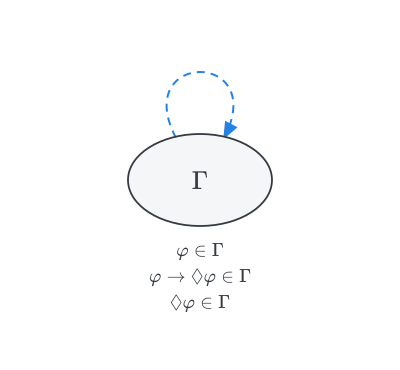
Proof. We argue that \(R_{\textsf{KT}}\) is reflexive on \(W_{\textsf{KT}}\): \(\Gamma R_{\textsf{KT}} \Gamma\) for each \(\Gamma \in W_{\textsf{KT}}\).
That is, if \(\Gamma\) is a maximal \(\textsf{KT}\)-consistent set, then for each modal formula \(\varphi\):
- if \(\varphi \in \Gamma\), then \(\Diamond \varphi \in \Gamma\).
Fix \(\varphi \in \Gamma\). Since \(\vdash_{\textsf{KT}} \varphi \to \Diamond \varphi\), \(\varphi \to \Diamond \varphi \in \Gamma\). By closure under \(\textsf{MP}\), \(\Diamond \varphi \in \Gamma\).
\(\textsf{D}\): seriality
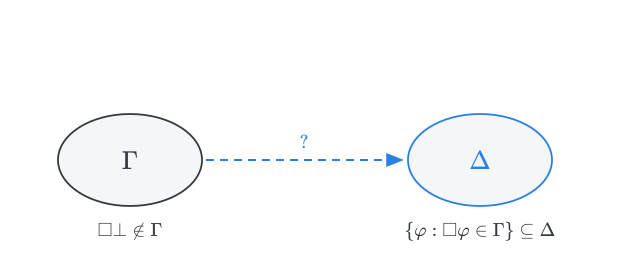
If \(\Sigma\) includes substitution instances of \(\textsf{D}\), then \(R_\Sigma\) is serial on \(W_\Sigma\): if \(\Gamma\) is a maximal \(\Sigma\)-consistent set, there is \(\Delta\) with \(\{\varphi : \Box\varphi \in \Gamma\} \subseteq \Delta\).
Proof. We argue that \(\{\varphi : \Box \varphi \in \Gamma\}\) is \(\Sigma\)-consistent. Suppose not. Then \(\vdash_{\Sigma} (\varphi_1 \wedge \dots \wedge \varphi_n) \to \bot\) for some \(\Box\varphi_1, \dots, \Box\varphi_n \in \Gamma\). By the lemma,
\[\vdash_\Sigma (\Box\varphi_1 \wedge \dots \wedge \Box\varphi_n) \to \Box \bot.\]
It follows that \(\Box\bot \in \Gamma\). Given axiom \(\textsf{D}\), \(\Diamond \bot \in \Gamma\). But \(\vdash_\Sigma \Box \neg \bot\), i.e., \(\neg\Diamond\bot \in \Gamma\). So, \(\Gamma\) is \(\Sigma\)-inconsistent, which contradicts the assumption that \(\Gamma\) is maximal \(\Sigma\)-consistent.
\(\textsf{B}\): symmetry
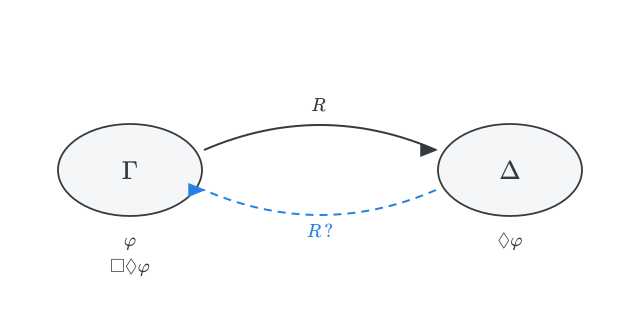
If \(\Sigma\) includes substitution instances of \(\textsf{B}\), then \(R_\Sigma\) is symmetric on \(W_\Sigma\): if \(\Gamma, \Delta\) are maximal \(\Sigma\)-consistent, then if \(\Gamma R_\Sigma \Delta\), then \(\Delta R_\Sigma \Gamma\).
Proof. Given maximal \(\Sigma\)-consistent sets \(\Gamma, \Delta\), we argue that
- if \(\{\varphi : \Box\varphi \in \Gamma\} \subseteq \Delta\), then \(\{\Diamond \varphi : \varphi \in \Gamma\} \subseteq \Delta\).
Let \(\varphi \in \Gamma\). By \(\textsf{B}\), \(\varphi \to \Box \Diamond \varphi \in \Gamma\), so \(\Box\Diamond\varphi \in \Gamma\). Since \(\Gamma R_\Sigma \Delta\), \(\Diamond \varphi \in \Delta\).
\(\textsf{4}\): transitivity
If \(\Sigma\) includes substitution instances of \(\textsf{4}\), then \(R_\Sigma\) is transitive on \(W_\Sigma\): if \(\Gamma, \Delta, \Theta\) are maximal \(\Sigma\)-consistent, then if \(\Gamma R_\Sigma \Delta\) and \(\Delta R_\Sigma \Theta\), then \(\Gamma R_\Sigma \Theta\).
Proof. Given maximal \(\Sigma\)-consistent sets \(\Gamma, \Delta, \Theta\), we argue
- if \(\{\varphi : \Box\varphi \in \Gamma\} \subseteq \Delta\) and \(\{\varphi : \Box\varphi \in \Delta\} \subseteq \Theta\), then \(\{\varphi : \Box\varphi \in \Gamma\} \subseteq \Theta\)
Assume \(\{\varphi : \Box\varphi \in \Gamma\} \subseteq \Delta\) and \(\{\varphi : \Box\varphi \in \Delta\} \subseteq \Theta\). Let \(\Box \varphi \in \Gamma\). By \(\textsf{4}\), \(\Box\Box\varphi \in \Gamma\). Since \(\Gamma R_\Sigma \Delta\), \(\Box \varphi \in \Delta\). Since \(\Delta R_\Sigma \Theta\), \(\varphi \in \Theta\).
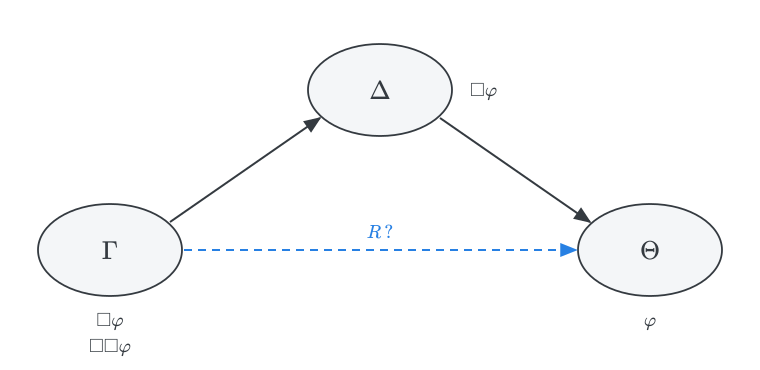
\(\textsf{5}\): euclidean condition
If \(\Sigma\) includes substitution instances of \(\textsf{5}\), then \(R_\Sigma\) is euclidean on \(W_\Sigma\): if \(\Gamma, \Delta, \Theta\) are maximal \(\Sigma\)-consistent, then if \(\Gamma R_\Sigma \Delta\) and \(\Gamma R_\Sigma \Theta\), then \(\Delta R_\Sigma \Theta\).
Proof. Given maximal \(\Sigma\)-consistent sets \(\Gamma, \Delta, \Theta\), we argue
- if \(\{\varphi : \Box \varphi \in \Gamma\} \subseteq \Delta\) and \(\{\Diamond \varphi : \varphi \in \Theta\} \subseteq \Gamma\), then \(\{\Diamond \varphi : \varphi \in \Theta\} \subseteq \Delta\)
Assume \(\{\varphi : \Box\varphi \in \Gamma\} \subseteq \Delta\) and \(\{\Diamond \varphi : \varphi \in \Theta\} \subseteq \Gamma\). Let \(\varphi \in \Theta\). Since \(\Gamma R_\Sigma \Theta\), \(\Diamond \varphi \in \Gamma\). By \(\textsf{5}\), \(\Box \Diamond \varphi \in \Gamma\). Since \(\Gamma R_\Sigma \Delta\), \(\Diamond \varphi \in \Delta\).
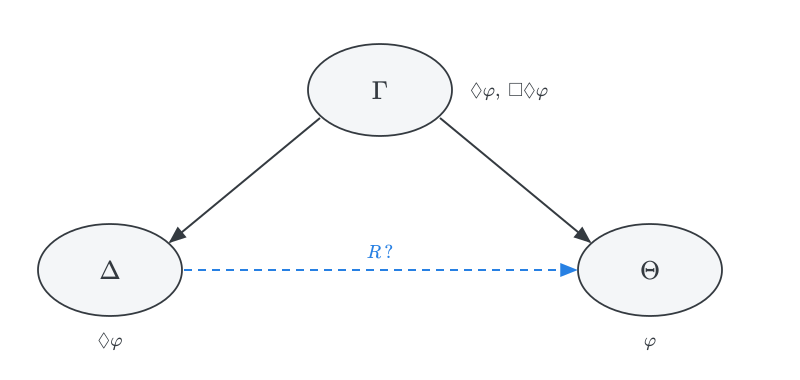
the full picture
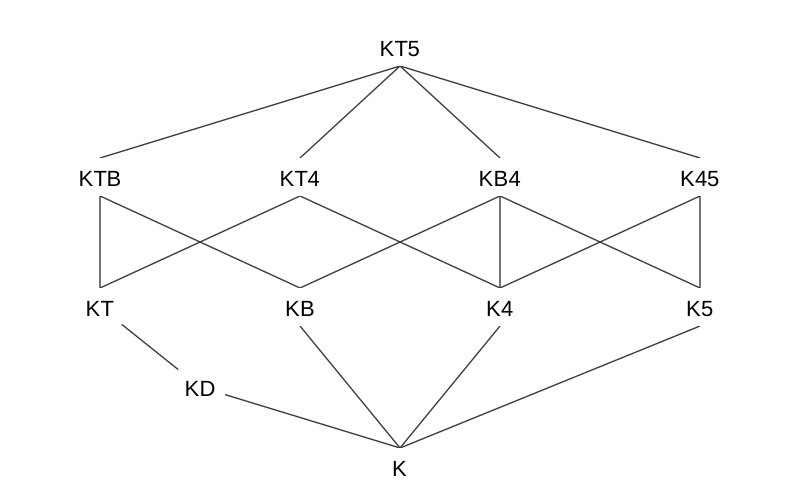
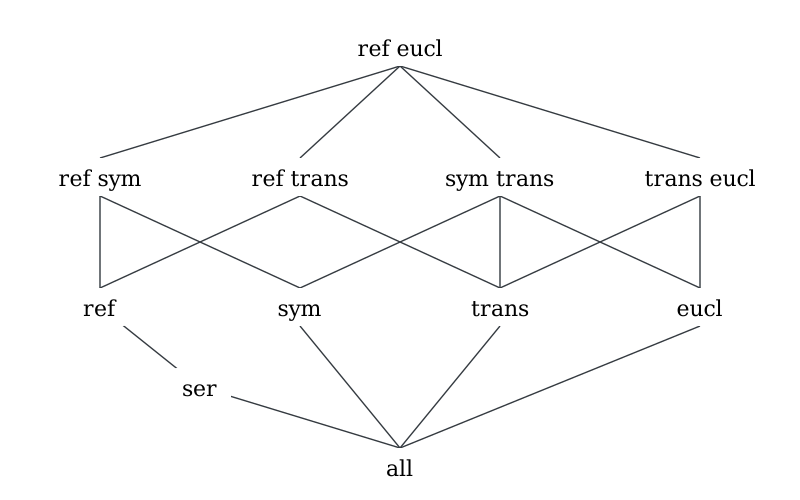
Combined with soundness, each system in the landscape characterizes the corresponding class of frames. Soundness holds because each axiom is valid on the frames that satisfy its condition (frame definability), and \(\textsf{MP}\) and \(\textsf{RN}\) preserve validity on any class of frames.
why \(\textsf{GL}\) is not canonical
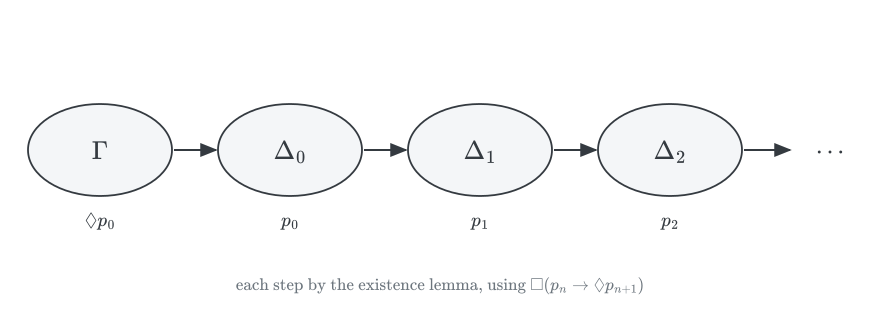
The set \(\{\Diamond p_0\} \cup \{\Box(p_n \to \Diamond p_{n+1}) : n \geq 0\}\) is \(\textsf{GL}\)-consistent: each finite subset is true at the root of a long enough finite chain. Extend it to a maximal \(\textsf{GL}\)-consistent \(\Gamma\).
Since \(\Diamond p_0 \in \Gamma\), there is \(\Delta_0\) with \(\Gamma R_{GL} \Delta_0\) and \(p_0 \in \Delta_0\). Since axiom \(\textsf{4}\) each instance of \(\Box(p_k\to\Diamond p_{k+1})\) is placed into each \(\Delta_n\). So \(p_n \to \Diamond p_{n+1}\in\Delta_n\), hence \(\Diamond p_{n+1}\in\Delta_n\), and the existence lemma gives \(\Delta_{n+1}\) with \(p_{n+1}\in\Delta_{n+1}\).
So the canonical frame contains an infinite chain, and it does not validate Löb’s axiom. Completeness of \(\textsf{GL}\) requires the use of alternative methods, such as filtrations and finite models.
exercise: \(\textsf{S4.2}\)
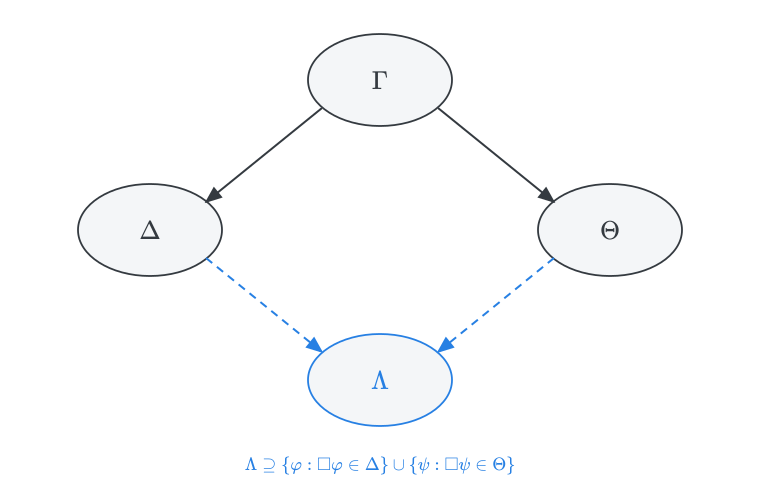
\(\textsf{S4.2}\) extends \(\textsf{S4}\) with all instances of \[\Diamond\Box p \to \Box\Diamond p \tag{\textsf{.2}}\]
\(\textsf{.2}\) is canonical for directed frames: if \(\Gamma R_\Sigma \Delta\) and \(\Gamma R_\Sigma \Theta\), then there is \(\Lambda\) with \(\Delta R_\Sigma \Lambda\) and \(\Theta R_\Sigma \Lambda\).
Hint: show that \(\{\varphi : \Box\varphi \in \Delta\} \cup \{\psi : \Box\psi \in \Theta\}\) is \(\Sigma\)-consistent, and use Lindenbaum’s lemma.