8 Against Temporal Parts
Before she argues against the doctrine of temporal parts, (Thomson 1983) discusses a potential application for a problem in metaphysics of material objects. Consider the following situation:
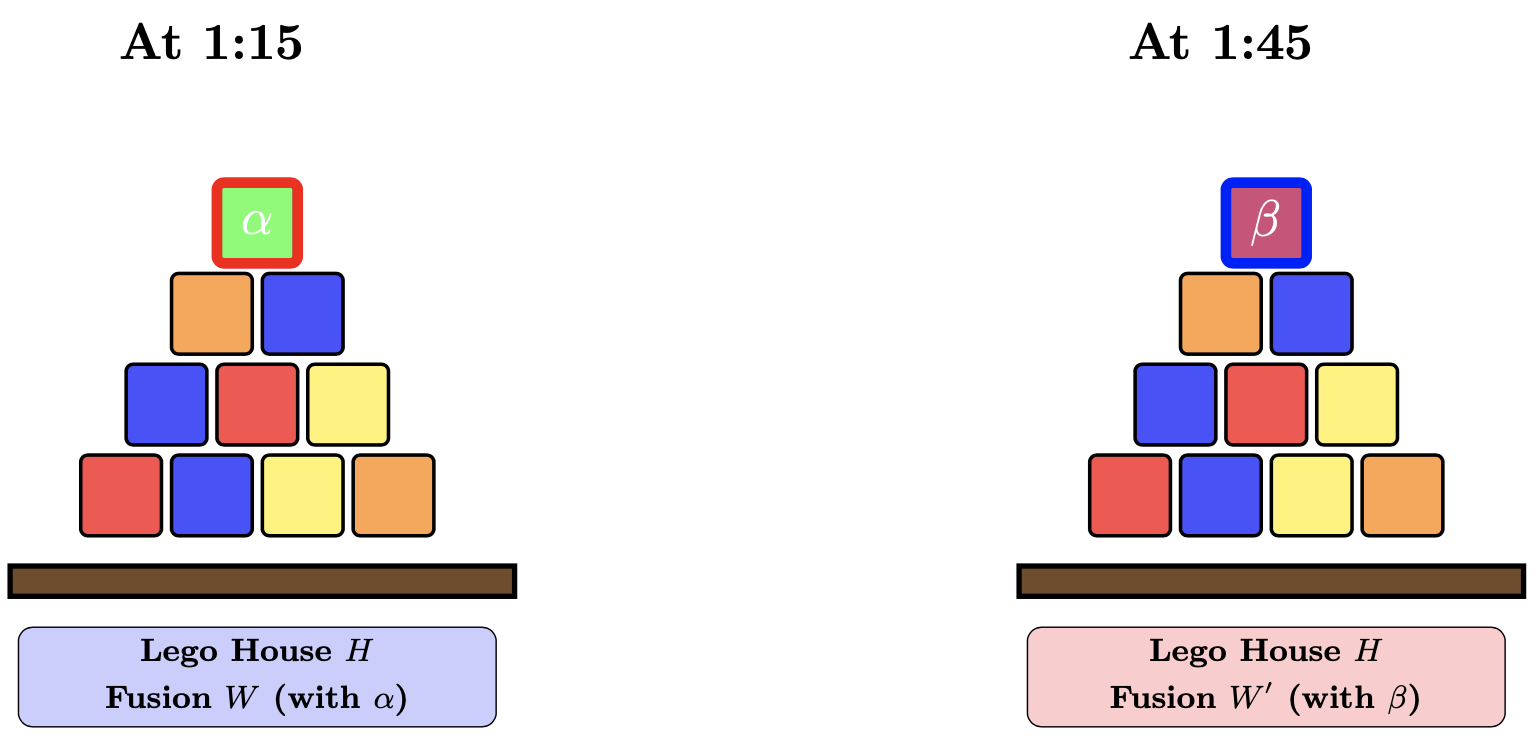
The Lego house is wholly present on the shelf at 1:15.
The Lego alpha is part of the Lego house at 1:15.
The Lego alpha is not part of the Lego house at 1:45.
The Lego house is not wholly present on the shelf at 1:45.
We will revisit the endurantist approach to the problem later. In the meantime (Thomson 1983) motivates the doctrine of temporal parts as potential solution to a related puzzle:
\(H\) is the Lego house on the shelf at 1:15
\(W\) is the fusion of the set of Legos on the shelf at 1:15
Since the Lego house on the shelf is made of Legos, we have reason to think that the fusion of Legos is part of the Lego house. On the other hand, the Lego house is nothing over and above the Legos, which suggests that the house too is part of the fusion of the set of Legos:
\[ W \leq H \wedge H \leq W \]
By anti-symmetry of part:
- \(H = W\)
The problem arises when we take into account the fact that the Lego house survives the replacement of one of the Legos, alpha, with another, beta, at 1:30. For, on the one hand, since the Lego house survives the replacement of one Lego for another:
- \(H\) is on the shelf at 1:45
But the set of Legos that makes up the house at 1:15, \(S\), is different from the set of Legos that makes up the house at 1:45, \(S'\): \(S\) contains alpha but not beta, whereas \(S'\) contains beta but not alpha. Unfortunately, the conjunction of 3 and 4 entail something false:
- \(W\) is on the shelf at 1:45 ?
For recall that \(W\) is the fusion of \(S\), which is by the lights of Classical Mereology different from the fusion of \(S'\), which contains beta instead of alpha.
Something must give.
8.1 Temporal Parts to the Rescue?
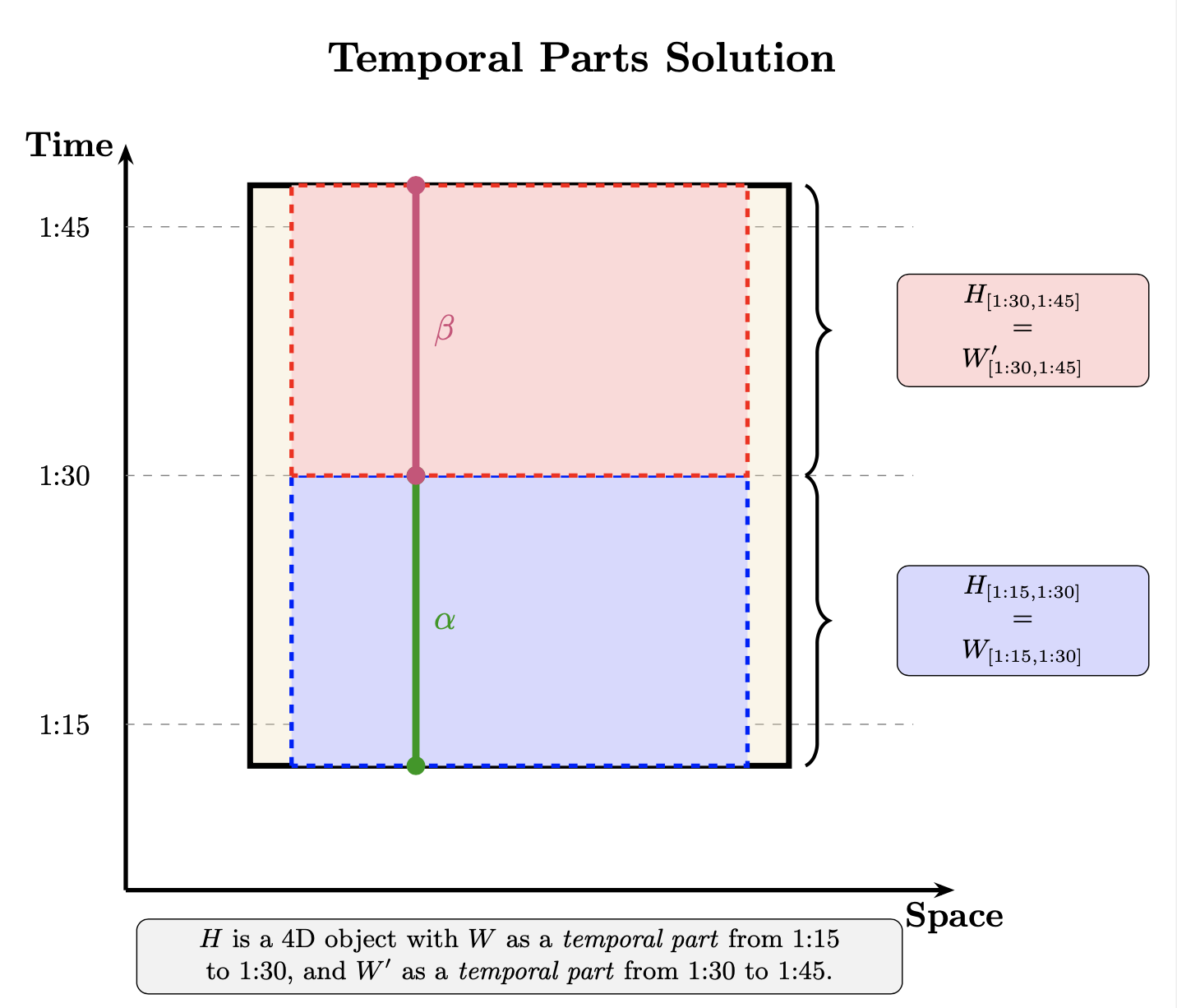
Four-dimensionalism appears to offer a solution. The Lego house \(H\) and the fusion \(W\) of the set of Legos are temporally extended four-dimensional objects. In fact, we should distinguish between \(H\) and \(W\), respectively, and the temporal parts \(H\)-from-1-to-1:30 and \(W\)-from-1-to-1:30. We made a mistake when we identified \(H\) with \(W\). What we have instead is:
- \(H\)-from-1-to-1:30 = \(W\)-from-1-to-1:30.
The Tinkertoy house shares a temporal part with the fusion \(W\) of the set of Legos \(S\), but it shares another temporal part with the fusion \(W'\) of the set of Legos \(S'\), which contains beta in place of alpha:
- \(H\)-from-1:30-to-1:45 = \(W'\)-from-1:30-to-1:45.
8.2 Against Temporal Parts
Unfortunately, there are concerns to be raised against the metaphysics of temporal parts we just deployed.
8.2.1 Precise Temporal Boundaries
One preliminary objection is that objects now appear to have sharp temporal boundaries, which, on the face of it, is not how we think of ordinary objects. Here is how (Thomson 1983) puts the objection in p. 209:
do ‘times’ have ‘sharp boundaries’? If so, something that is presumably false now follows. Consider a common or garden physical object – my chair, for example. [Four-dimensionalism] tells us it is a temporal part of itself. The definition of ‘temporal part’ tells us that this means there is a time such that my chair exists through and such that no part of my chair exists outside and so, in particular, such that my chair itself does not exist outside . But is there? Is there a time-point such that my chair was in existence at and at no time before ?
The thought is that four-dimensionalism cannot do justice to the fact that a chair may come with indeterminate temporal boundaries: instead, we have a variety of temporally perfectly precise candidates for being the chair. Unfortunately, this is just a temporal variation on the problem of the many, which arises for the three-dimensionalism as soon as we consider the spatial boundaries of the chair.
8.2.2 Unexpected Parts
Four-dimensionalism appears to be at odds with ordinary judgments when it comes to what is part of what. Here is how (Thomson 1983) puts the objection in p. 210:
my chair exists through and only through \(T\) and no part of it exists before \(T\). Now my chair was made out of wood: four wooden legs, a wooden seat, and a wooden back were screwed together to make that chair. So the legs, seat, and back existed before the chair existed; so neither the legs, seat, nor back of the chair are parts of the chair. What an absurd result to have arrived at!
The concern is that neither the legs, nor the seat, nor the back of my chair are in fact parts of my chair. But it seems like the four-dimensionalism should be able to recover parallel judgments. The back of my chair overlaps the chair at times at which they exist. They have a common temporal part at t, and at the temporal part of the back at t is a spatial part of the temporal part of the chair at t. To be more precise,
- the back is part of the chair at t
because
- the back-at-t is part of the chair-at-t.
8.2.3 Separation
I can break the bit of chalk in half. … If I do, I will have something in my right hand which is white, roughly cylindrical in shape, dusty, etc.; and it could hardly be said that that thing will come into existence at breaking time – surely the thing does exist before I break it (note that ‘it’) off. And surely the thing does exist now, even if I never break it off.
There is no analogous pressure to say that there is such a thing as [the later temporal half]. (Homework: try breaking a bit of chalk into its two temporal halves.)
Presumably, to break an object into some spatial parts is something we can do over time. There is, first, a connected three-dimensional region occupied by the object at t, and then there is a disconnected three-dimensional region occupied by the fusion of the parts at a later time t’. There is no analogous dimension of variation for the temporal path of the object, which is not something that changes over time.
8.2.4 A Crazy Metaphysic?
I said this seems to me a crazy metaphysic. It seems to me that its full craziness comes out only when we take the spatial analogy seriously. The metaphysic yields that if I have had exactly one bit of chalk in my hand for the last hour, then there is something in my hand which is white, roughly cylindrical in shape, and dusty, something which also has a weight, something which is chalk, which was not in my hand three minutes ago, and indeed, such that no part of it was in my hand three minutes ago. As I hold the bit of chalk in my hand, new stuff, new chalk keeps constantly coming into existence ex nihilo. That strikes me as obviously false.
(Sider 2003) responds:
The four-dimensionalist does indeed claim that the piece of chalk has a temporal part at every moment at which it exists, and that those temporal parts are white, cylindrical, and dusty. But in saying that temporal parts come into existence ex nihilo, Thomson makes it sound as if a miracle is constantly occurring. That isn’t right. The sensible four-dimensionalist will claim that current temporal parts are caused to exist by previous temporal parts. The laws that govern this process are none other than the familiar laws of motion. … Thus, if emergence ex nihilo is understood as uncaused or inexplicable emergence, Thomson is mistaken; and it is unclear what other sense these words may be given on which the argument is compelling.
8.3 How to Relativize Part to Times
(Thomson 1983) offers a different response to the initial puzzle, and the proposal relies on a relativization of the relation of part to whole to a time:
\[ x \leq_t y \tag{$x$ is part of $y$ at $t$} \]
We may lay axioms to govern the behavior of the temporal relativization of part, but notice that we are now able to define what is for something to exists at \(t\) in terms of the new relation:
\[ \begin{array}{lll} \textsf{E}_t & := & x \leq_t x & \text{($x$ exists at $t$)} \end{array} \]
Some definitions:
\[ \begin{array}{lll} x \circ_t y & := & \exists z (z \leq_t x \wedge z \leq_t y) & \text{($x$ overlaps $y$ at $t$)}\\ x Fu_t S & := & \textsf{E}_t x \wedge \forall z (z \leq_t x \leftrightarrow \exists y (y \in S \wedge z \circ_t y)) & \text{($x$ is a fusion of $S$ at $t$)} \end{array} \]
What is important is that we are now only entitled to a weakened form of anti-symmetry:
\[ \forall t ((\textsf{E}_t x \wedge \textsf{E}_t y) \to (x \leq_t y \wedge y \leq_t x)) \to x = y \]
That is, two objects are identical if they share exactly the same parts at all times at which they exist.
We are now in a position to revisit the initial puzzle, which began with the observation:
- \(H\) is the Lego house on the shelf at 1:15.
One issue now is that there is no such thing as the fusion of the Legos on the shelf at 1:15. Fusion, you may remember, is relativized to times, which means we are at most entitled to:
- \(W\) is the unique object that fuses at 1:15 the Legos on the shelf.
But we are no longer entitled to the atemporal judgments that \(H \leq W\) and \(W \leq H\). At most, we have this:
\[ H \leq_{1:15} W \wedge W \leq_{1:15} H \]
But that is not sufficient to infer that \(H\) and \(W\) are one and the same thing. To reach that conclusion, we would need to make sure that they share the same parts at all times at which they exist. Unfortunately, they do not. At 1:30, beta is part of \(H\) but not part of \(W\).
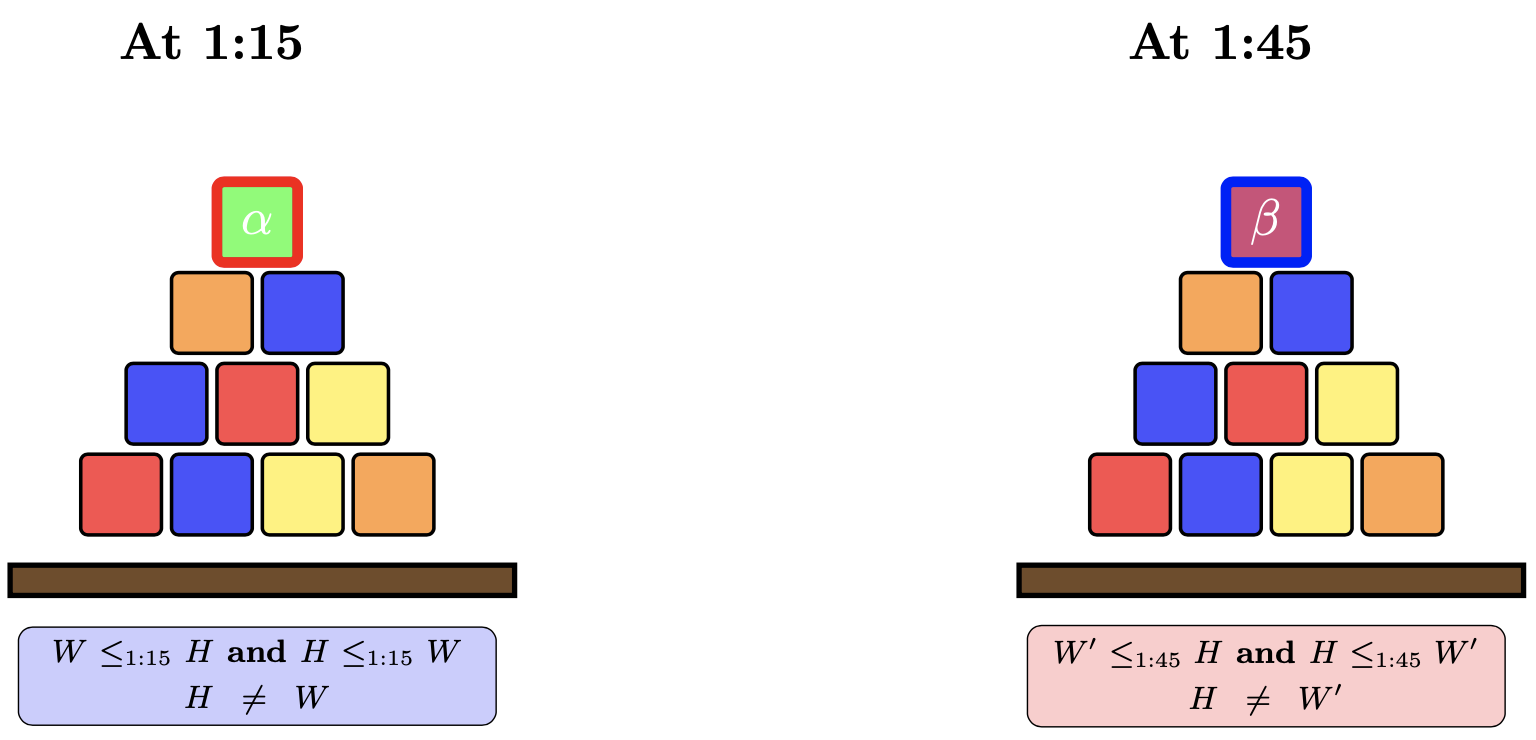
There are at least two objections in the offing. Even if \(H\) and \(W\) are not identical, not only do they share all of their parts at 1:15, but they even seem to occupy the same region of space at the same time. But how could two distinct material objects occupy the same region of space at the same time?
8.4 Endurance Revisited
Let us now return to the distinction between perdurance and endurance, which (Lewis 1986) characterized as follows:
To endure is to be wholly present at more than one time within a certain interval.
One may be tempted to rephrase talk of being wholly present in terms of the presence of all parts of the relevant object:
To be wholly present at a time \(t\) is to have all of one’s parts be present at \(t\)
The Lego House is, for the endurantist, wholly present from 1:15 to 1:45. That is, all of its parts are present at each and every time between 1:15 and 1:45. But since the relation of part to whole is temporary, we have to sharpen the interpretation further. One option is to require all of one’s parts at t to be present at t:
The Lego House is wholly present at 1:45 iff every part of the Lego House at 1:45 is present at 1:45
This is true both by the lights of every party in the debate. The perdurantist agrees that every part of the Lego House at 1:45 exists at 1:45, which means that that cannot be the source of disagreement.
The other option is to demand more. It is not just that all one’s parts at t must be present at t, all of one’s parts at one time or another must be present at t:
The Lego House is wholly present at 1:45 iff every part of the Lego House at one time or another is present at 1:45
That is not something anyone should agree to. For consider the case in which alpha is in fact annihilated after being replaced with beta at 1:30pm. That would be a case in which something, namely, alpha, which is part of the Lego House at 1:15pm is not present at 1:45pm when the Lego House is still present.